
Project Details
- Project Location
- Puyang, Henan Province, China
- Configuration
- 6 × XY-8-P/PB batch-type horizontal rotary pyrolysis plants
- Combined Design Capacity
- 72 TPD (6 × 12 TPD per-unit design capacity)
- Feedstock
- Waste tires
- Project Year
- 2018
- Original Project Status
- Delivered and commissioned in 2018; documented in project records and photographs from the installation and commissioning period.
- Current Operating Status
- Not independently verified
- Supplier
- Shangqiu Jinpeng Industrial Co., Ltd. (PYROJIN)
In a city where four batch pyrolysis lines for the same feedstock were being installed in the same year, adding six more was not primarily a technology decision. Puyang, an oil-industry city in northern Henan, concentrates waste-tire generation through its freight corridors, industrial vehicle fleets, and the transport network around its oilfield region. The interesting question in this 2018 archive project is not whether batch pyrolysis could work in Puyang; it is whether a six-unit plant with a 72 TPD combined design capacity could be fed reliably where another operator was building four units at the same time. The documented configuration was designed around exactly that question.
Project Background & Configuration Logic
Oil-city geography explains both the opportunity and the constraint in Puyang. Oilfield operations, petrochemical-linked industry, and dense truck and passenger traffic generate high tire turnover, concentrating end-of-life tires in a relatively small area. For a waste-tire processor that density is double-edged: a dense catchment can support a larger installation, but it also attracts more operators - so feedstock intake, not reactor technology, becomes the binding constraint.
This is the logic behind a six-unit configuration. Six batch reactors at 12 TPD each give a combined design capacity of 72 TPD, an appetite only a catchment with dependable tire supply can justify. The configuration was designed to convert catchment density into throughput: the six lines share one site, common storage, and utility connections, run as a coordinated schedule rather than as six independent plants. Staged loading and rotating discharge keep feedstock moving while individual reactors progress through their batch cycles. The same reasoning distinguishes this plant from the other Puyang operator's four-unit, 12 TPD batch configuration, also documented for 2018: two operators and ten batch lines in one city indicate an established market where configuration choice is an intake strategy as much as a capacity decision.
Core Technology & Production Analysis
Feedstock Intake: The First Design Problem
For a site with a 72 TPD design appetite, intake planning matters more than reactor details. The design accommodates whole or cut tires loaded in batches; cutting improves packing density and simplifies handling. In a competitive catchment, intake cadence - how many loads arrive, on what schedule, from which collectors - determines whether all six lines stay fed. Storage was therefore planned for buffer volume: covered space to smooth daily intake fluctuations without letting feedstock quality deteriorate. Feedstock density makes the project possible; intake discipline makes it run.
Six Reactors, One Site Rhythm: Batch Scheduling
A 12 TPD batch reactor follows a cycle in the order of 22-24 hours: loading roughly two hours, preheating around four, the pyrolysis stage about ten, cooling four to six, and discharge about two. With six reactors, the scheduling problem is phasing these cycles so loading and discharge do not collide. Staggered starts, shared utilities sized for the schedule's peak rather than the sum of all lines, and rotating discharge keep labor demand at the one-to-two operators per plant the equipment family is designed for. Six reactors in phase behave like one large batch unit with six idle gaps; out of phase, they spread loading and discharge across the day. Because each reactor is an independent vessel, one line can be taken offline for maintenance without stopping the site.
The Rotary Batch Reactor: Indirect Heating Under Micro-Negative Pressure
Each line is a horizontal rotary reactor in boiler steel (Q345R), rotating slowly (about 0.4 r/min) so the charge turns and heat exposure stays even. Heating is indirect - direct-fired or hot-air - so the feedstock never contacts the flame, and the reactor operates under inert, anaerobic conditions at micro-negative pressure, a design intended to prevent gas escape to the workshop atmosphere. This combination is what allows whole-tire feedstock to be processed in a batch vessel without combustion of the material itself - the design characteristics of Jinpeng's XY-8-P/PB batch family documented for this project.
Condensation and the Product Boundary
The vapor stream passes through the condensation system, where condensable fractions are collected as pyrolysis oil. The oil is a fuel-oil-type product, not diesel: reaching a standard such as EN590 would require further distillation, hydrotreating, and certification testing beyond the pyrolysis plant itself. No fixed oil yield is claimed here; actual yields and oil properties depend on the tire mix, operating conditions, and testing. That boundary matters commercially - buyers need to know what the plant produces and what it does not.
Gas and Solids Handling
Non-condensable gas from the process may be returned to the heating system where the installed design and operating conditions permit, reducing purchased fuel demand. The solid residue is recovered carbonaceous material - not commercial-grade carbon black unless deep-processed and tested - and the steel wire is separated as a further recovered stream. Flue gas passes through the installed treatment train, typically a spray tower for alkali neutralization followed by an adsorption tower for desulfurization and dedusting, designed to meet local emission requirements under proper operating conditions. The design intent is containment and control of the process and flue-gas streams.
Two Operators, One Catchment
The most instructive comparison in Puyang is between its two documented operators. Mr. Yang's six-unit, 72 TPD design-capacity configuration and Mr. Shen's four-unit, 48 TPD configuration were both installed in 2018, both batch, both on waste tires. The six-unit choice signals a larger intake commitment and a schedule built to absorb more feedstock per day; the four-unit choice, a smaller appetite with more headroom for intake gaps. Together they show that in a mature catchment the differentiator is not the reactor but the procurement and scheduling system around it. Either scale can work; what has to match is the catchment's real, deliverable tire volume.
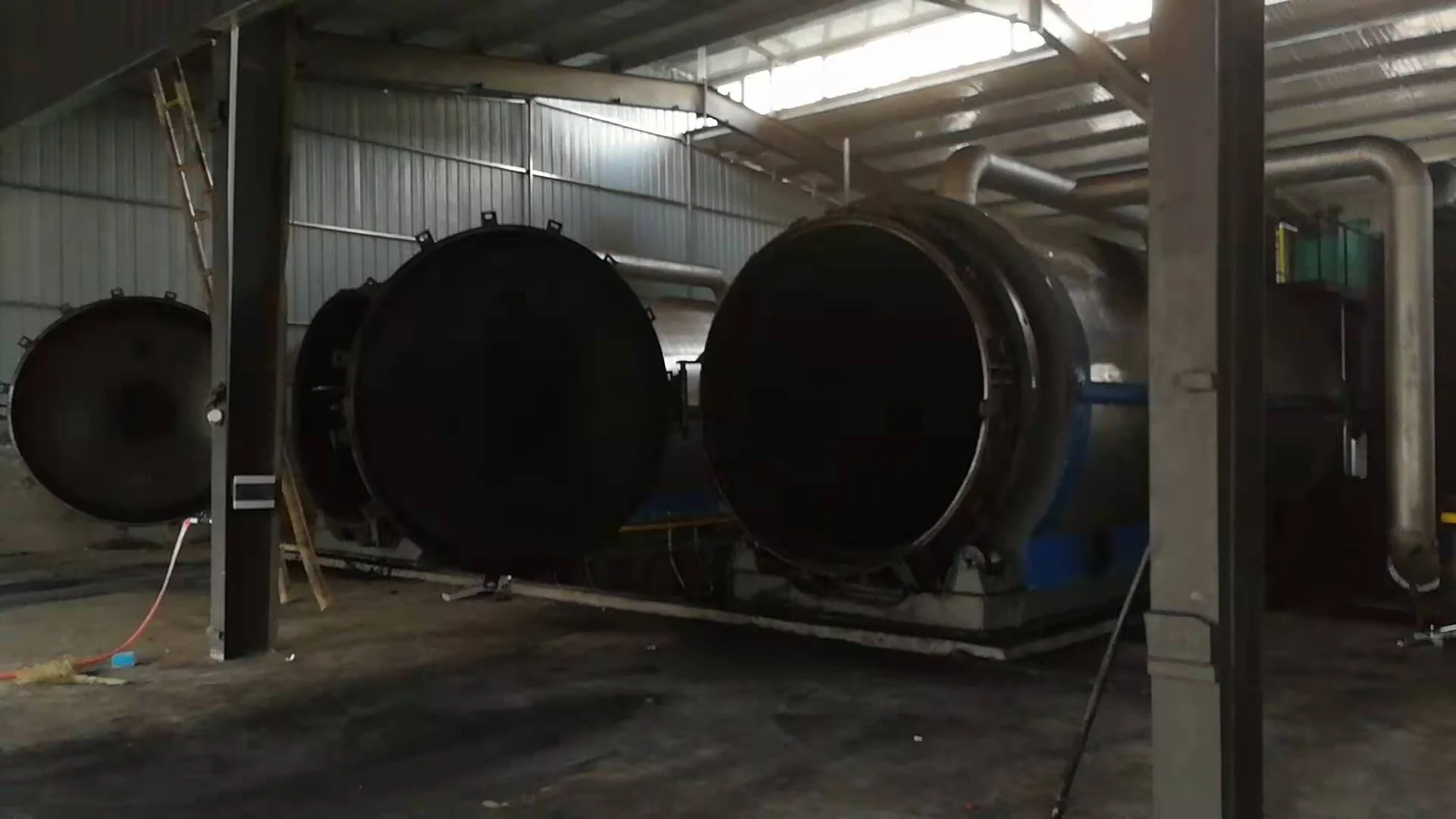
Overall site photograph showing the layout and scale of the six-reactor configuration in Puyang, Henan. Photo taken during installation and commissioning in 2018.
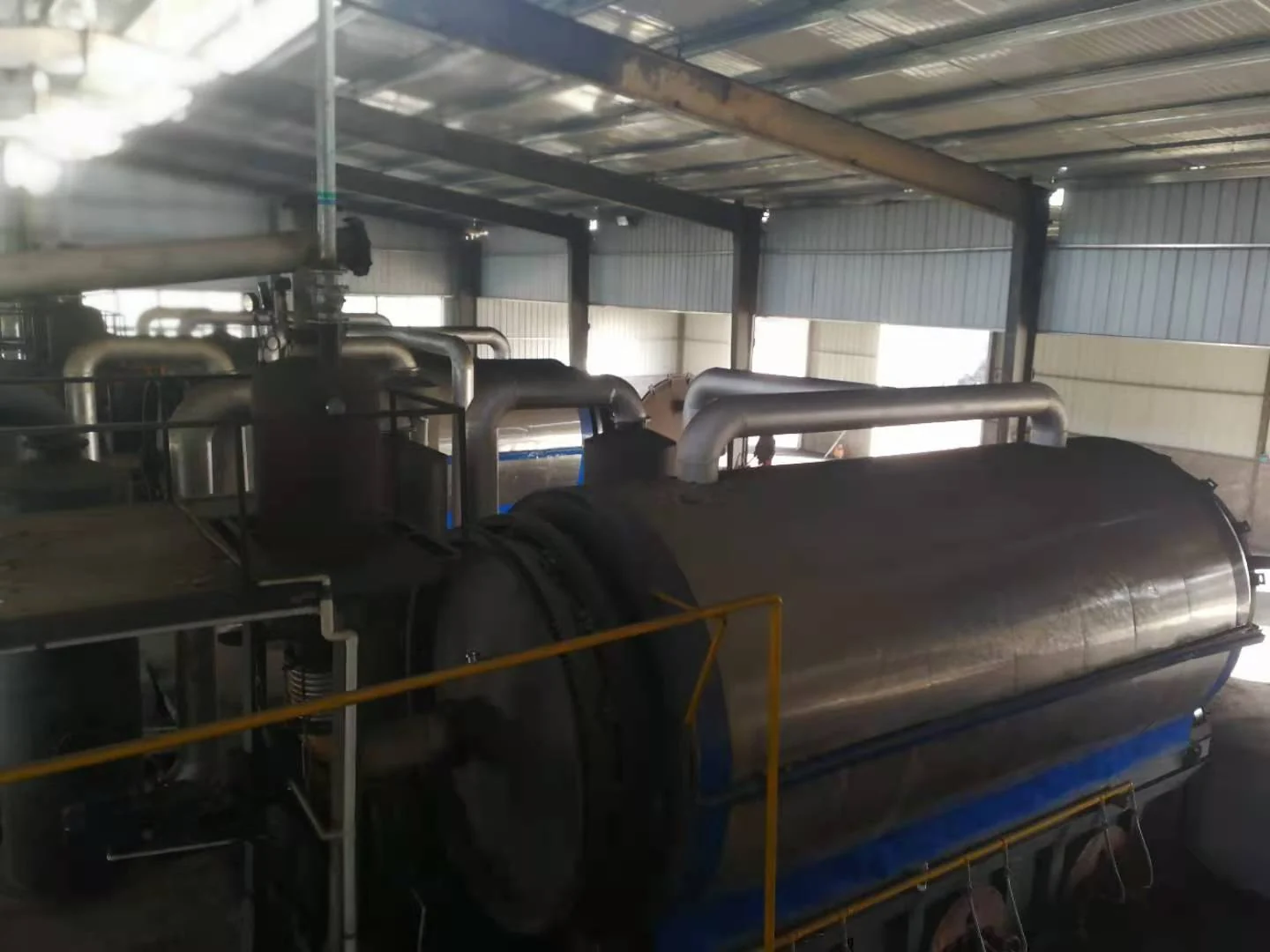
Process detail photograph of reactor and process equipment at the Puyang, Henan site. Photo taken during installation and commissioning in 2018.
Project Specifications
| Item | Project specification |
|---|---|
| Location | Puyang, Henan Province, China |
| Project year | 2018 |
| Status | Historical archive project; delivered and commissioned in 2018; current operating status not independently verified |
| Feedstock | Waste tires (whole or cut, batch loading) |
| System | XY-8-P/PB batch-type horizontal rotary pyrolysis system, indirect heating, micro-negative pressure |
| Number of units | 6 |
| Capacity per unit | 12 TPD (design capacity) |
| Combined design capacity | 72 TPD (6 × 12 TPD, design value) |
| Production model | Batch (loading, preheat, pyrolysis, cooling, discharge cycles) |
| Main recovered streams | Pyrolysis oil (fuel oil), recovered carbonaceous material, steel wire; non-condensable gas may be returned to heating where the installed design and operating conditions permit |
| Supplier | Shangqiu Jinpeng Industrial Co., Ltd. (PYROJIN) |
What the Project Demonstrates
This archive project demonstrates Jinpeng's ability to configure and supply a six-unit batch site - the scheduling logic, shared-utility design, and intake planning that make multiple batch lines function as one plant. For a client considering large batch scale in a concentrated feedstock region, the Puyang example shows that the configuration question is an intake question: how much feedstock the catchment can deliver, how much storage and labor the site can carry, and how the batch schedule is phased across the lines. Evaluators should watch whether planned intake matches design capacity, how the site handles intake peaks and gaps, and how product streams are stored and dispatched. The project also documents that more than one operator can be viable in one city when each configuration matches a realistic share of the catchment's tires.
About Jinpeng
Shangqiu Jinpeng Industrial Co., Ltd. designs and manufactures batch, semi-continuous, and continuous pyrolysis plants, oil distillation systems, and supporting equipment for waste tires, waste plastics, oil sludge, rubber-derived materials, and other suitable carbon-rich feedstocks. Project configuration is developed around material characteristics, production objectives, site conditions, and applicable local requirements. For project discussions, visit www.pyrolysis-machine.com.
Disclaimer
All capacities are design values, not guaranteed outputs; actual throughput depends on feedstock characteristics, site conditions, and operating practices. Product yields and properties are not fixed and must be established by testing for each feedstock mix. Energy and emissions performance depends on the auxiliary systems installed, operating conditions, and compliance with local regulations; the final design must be reviewed against applicable requirements. This article is a retrospective description of a documented project configuration, not a verification of the plant's current operation.
Archive Note: This retrospective is based on Jinpeng's project records and photographs from the original delivery and commissioning period. It describes the documented project configuration and does not constitute verification of the plant's current operating status.