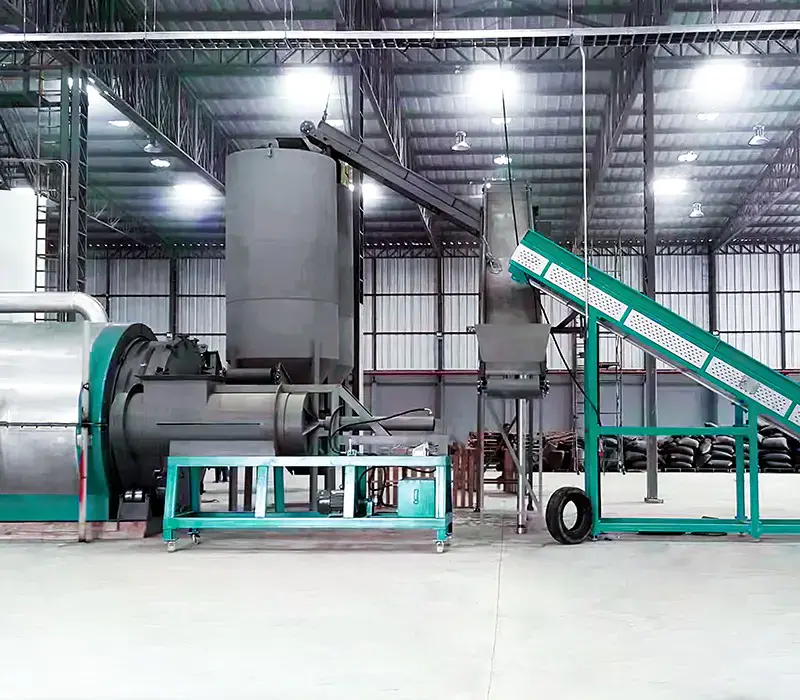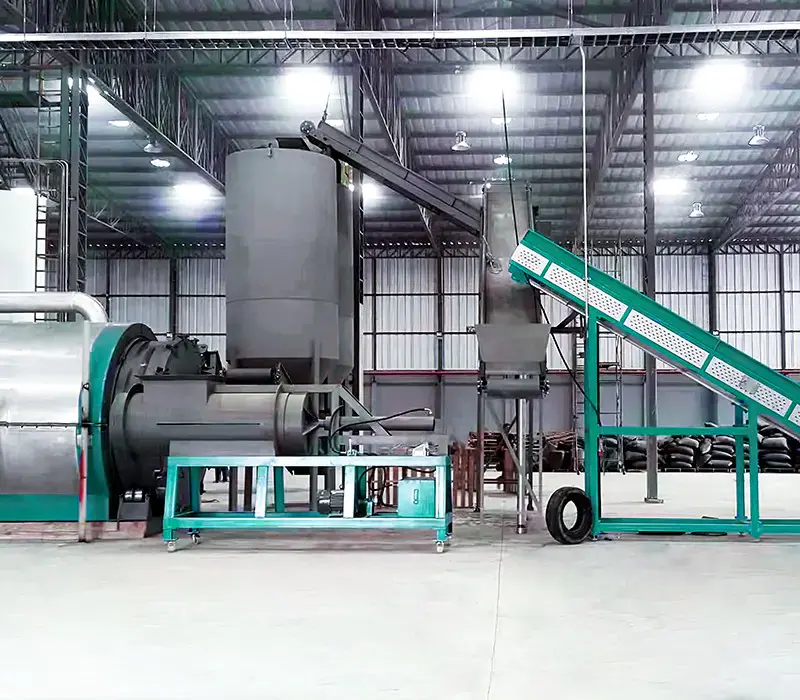
How a Continuous MSW Pyrolysis Plant Works
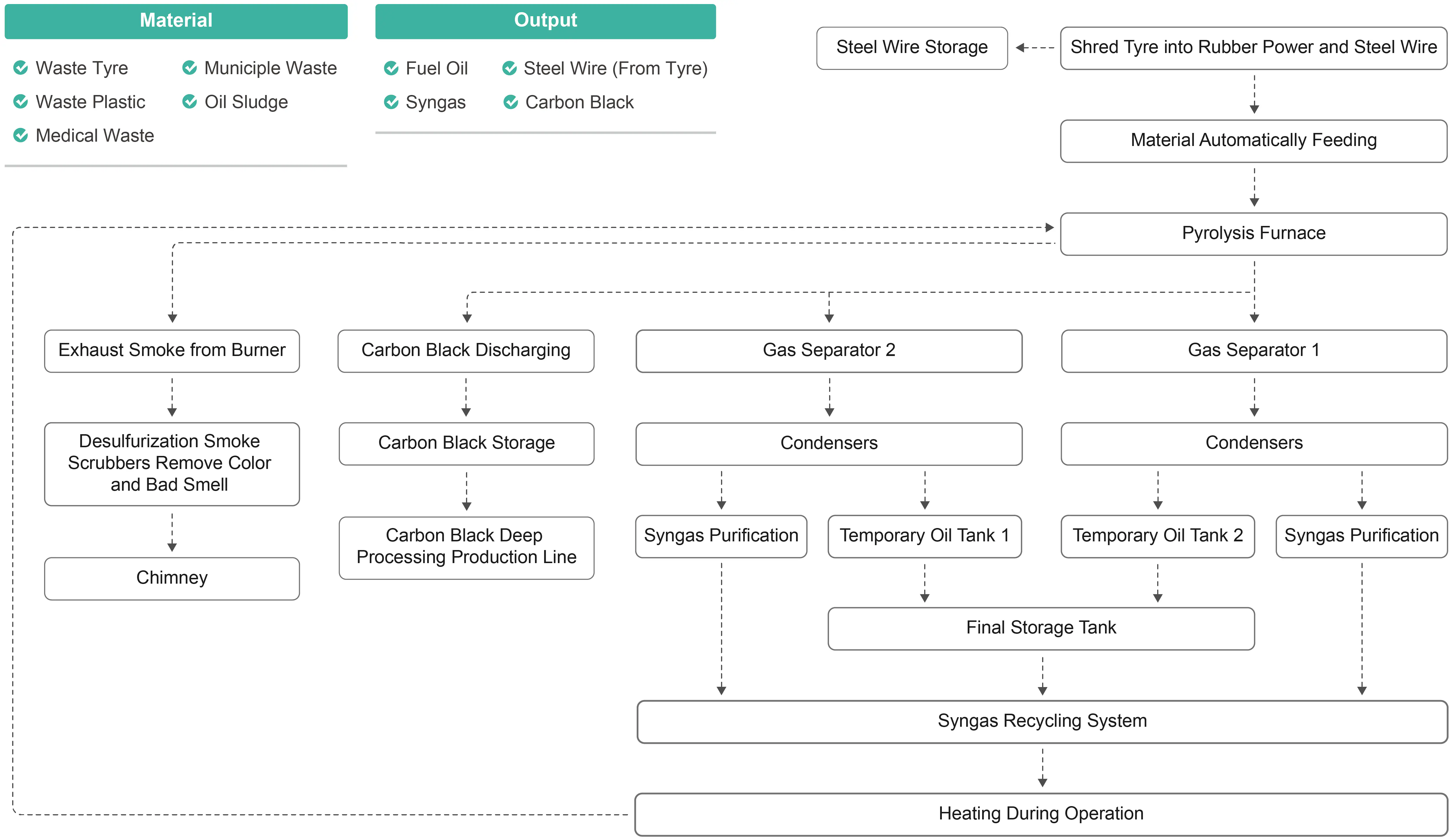
- Unsorted municipal waste is fed through a sealed, negative-pressure system.
- A pre-shredding system crushes the waste to even out particle size and improve conversion uniformity.
- The waste is heated under slight negative pressure with no oxygen contact, in a dual-stage pyrolysis + gasification process.
- Up to 85% of the input is converted into syngas, with the balance leaving as solid char/residue.
- Cleaned non-condensable gas is recycled to fuel the furnace, cutting external energy use by about 50%.
- Flue gas is treated through alkali neutralisation and an adsorption tower before Treated discharge; residue is discharged through a water-cooled screw conveyor.
Models and Specifications
| Model | PC-30 | PC-40 | PC-50 |
|---|---|---|---|
| Capacity | 30 t/day | 40 t/day | 50 t/day |
| Furnace size | φ1700×12500 mm | φ2500×12500 mm | φ2500×15000 mm |
| Gross weight | 90 t | 100 t | 150 t |
| Working power | 100-120 kW | 100-120 kW | 100-120 kW |
| Heating method | Indirect heat (oil, natural gas or electricity) | Indirect heat (oil, natural gas or electricity) | Indirect heat (oil, natural gas or electricity) |
| Working pressure | Slight negative pressure | Slight negative pressure | Slight negative pressure |
| Shipping | 2×FR+5×40' HQ | 2×FR+5×40' HQ | 4×FR+5×40' HQ |
Series capacity covers 20-50 t/d; PC-30/40/50 are the three standard models. Main reactor runs at slight negative pressure, horizontal rotation 0.3 rpm, circulating-water cooling, noise ≤85 dB, installation footprint approx. 50 m × 20 m, 1-2 operators per shift.
Outputs: Syngas, Char and Residue
- Solid char / residue - sealed discharge through a water-cooled screw conveyor.
Key Equipment Features
- Pre-shredding system for unsorted municipal solid waste.
- Continuous negative pressure preventing odour leakage.
- Sealed, automated feeding and multi-stage sealed slag discharge (residue held at about 50 °C).
- Slight-negative-pressure gas containment with emission controls configured to project requirements.
- Self-powered gas recycling cutting about 50% of external energy use.
- Automatic cleaning system for furnace and condenser coke removal.
- Temperature-control system configured around the selected process.
- Auto-nitrogen safety system and centralised control console.
- Lean-manning automation (1-2 operators per shift).
Continuous vs Batch MSW Treatment
| Continuous (PC) | Batch (PB) | |
|---|---|---|
| Scale | ≥10,000 t/year | ≈3,000 t/year |
| Operation | 24/7 | Single furnace per day |
| Automation | High (1-2 operators) | Moderate manpower |
| Feedstock | Unsorted / pre-shredded MSW | Sorted / smaller volumes |
Choose continuous for centralised treatment of medium and large urban waste; choose batch for smaller or lower-budget projects.
Frequently Asked Questions
- What waste can be processed? Unsorted municipal solid waste and excavated landfill waste, with a pre-shredding stage.
- What is the delivery time? The delivery schedule and departure port are confirmed in the commercial quotation.
- What payment methods do you accept? Mainly T/T; other methods on request.
- Are you a factory or a trading company? We operate our own factory in Shangqiu, Henan, China.
- What is the warranty? Warranty, installation, training and maintenance support are defined in the supply contract.
- What information do I need for a quote? Waste composition, daily volume, project location and target output.
Get a Configuration Quote
Send your waste composition, daily volume and project location, and a Pyrojin engineer will prepare a matching line configuration, layout and output plan.
Equipment and project images