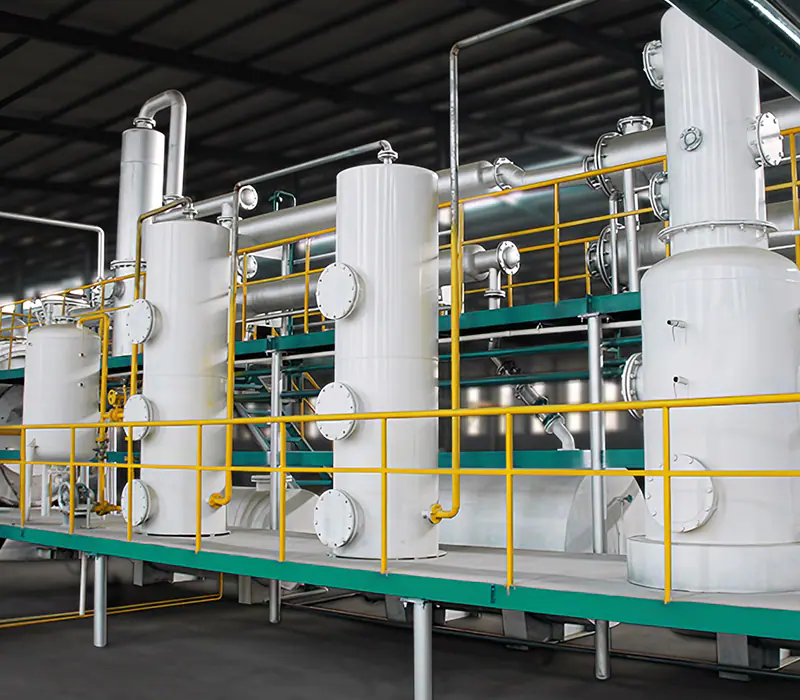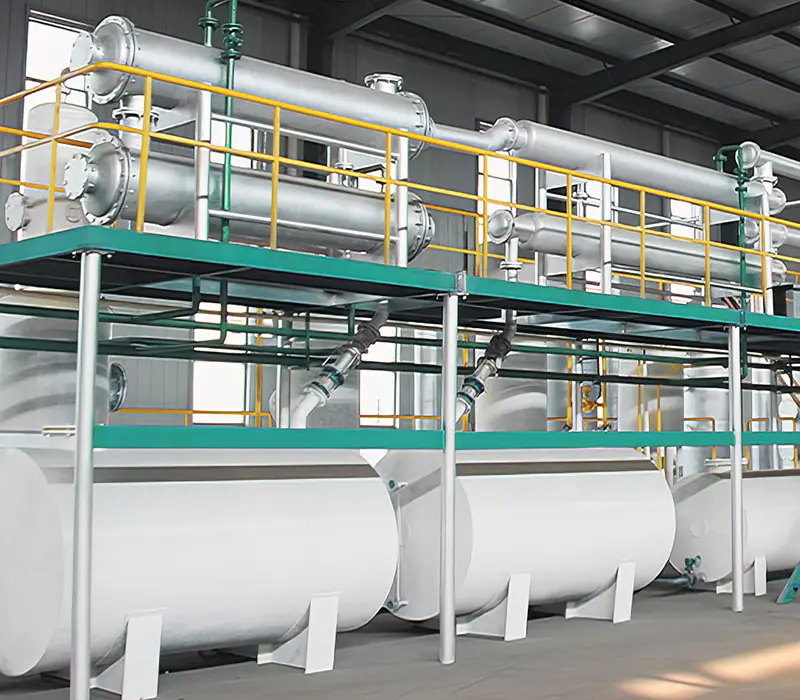
This DB-series batch distillation platform is configured for characterized tyre or plastic pyrolysis oil. The confirmed equipment-table range is 5-8 or 8-10 tonnes per day, with a reference oil yield of 80-90% and gross equipment weights of 55 or 60 tonnes. Actual fractions, product quality, heating duty and pressure configuration require feed analysis and a signed process specification; a vacuum stage is not promised unless it is included in that project specification.
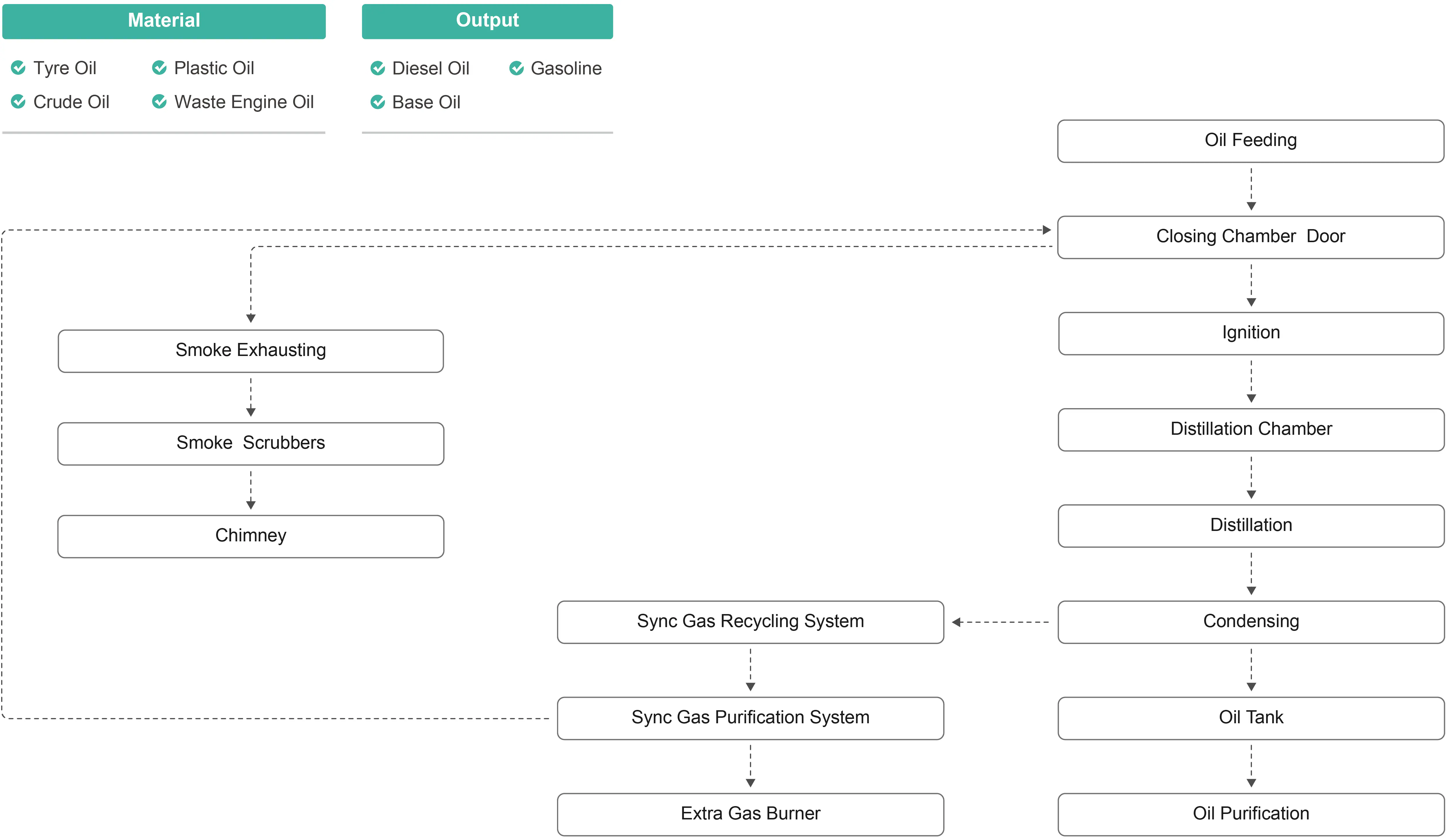
How an Atmospheric Distillation Plant Works
- Direct catalytic distillation - pyrolysis oil is pumped into the processor and catalytically heated to vaporize the oil.
- Vapor reforming and fractionation - the vapor reacts with catalysts, condenses, and is fractionated into base fuel oil.
- Fuel oil refinement - the base oil passes through sedimentation, filtration, chemical treatment and additive blending.
- Self-powered gas recycling - purified non-condensable gas is returned to fuel the processor burner, cutting energy use by about 30%.
- Emission-controlled flue gas treatment - alkali spray neutralization and an adsorption tower clean the flue gas before discharge (configured for project-specific emission-control requirements).
The whole process runs at normal (atmospheric) pressure, so there is no vacuum pump to maintain - a simpler structure with easier maintenance and lower operating cost, well suited to primary pyrolysis-oil processing. A high-efficiency catalytic tower or decolorization-and-deodorization unit removes acidic gases, sulfides and odor molecules for a cleaner, lighter-smelling fuel.
Models and Specifications
| Model | DB-8 | DB-10 |
|---|---|---|
| Capacity | 5-8 t/day | 8-10 t/day |
| Furnace size | Φ2500 × 8800 × 18 mm | Φ2500 × 11000 × 18 mm |
| Gross weight | 55 t | 60 t |
| Working power | 20-30 kW | 20-30 kW |
| Reference oil yield* | 80-90% | 80-90% |
| Heating method | Direct heat / hot air | Direct heat / hot air |
| Working type | Batch | Batch |
| Source-table pressure | Normal pressure | Normal pressure |
| Noise target | ≤85 dB | ≤85 dB |
| Shipping | 1×FR + 2×40' HQ | 1×FR + 2×40' HQ |
Both models are batch-type, horizontal static designs with circulating-water cooling. The source table lists normal pressure; any vacuum-stage configuration must be confirmed in the signed process specification. Installation footprint is approximately 35 m × 20 m, with 1-2 operators per shift.
Expected Output Fractions
- Light fuel oil (80-90% reference) - the primary output, tailored for industrial burners.
- Diesel fuel - recovered and stored separately from lighter and heavier fractions.
- Heavy oil - separated by the multi-layer distillation structure and stored separately to meet varied market needs.
Key Equipment Features
- Normal-pressure operation - no vacuum pump system, simpler structure, easier maintenance.
- Pre-filtration and thermal stabilization to remove impurities before distillation.
- Distillation column with structured packing for an 80-90% reference light fuel oil yield.
- Catalytic tower / decolorization-deodorization unit removes acidic gases, sulfides and odor.
- Multi-layer distillation structure recovers light fuel, diesel fuel and heavy oil separately.
- Customizable temperature zones for varied feedstock viscosities.
- Premium output quality - strict process control for consistent fuel oil to be tested against the buyer's required product specification.
- Efficient heating and maintenance - rapid non-stick heating walls minimize cleaning downtime.
- Triple-layer safety - submerged arc welding + ultrasonic NDT + dual alarm system.
- High-yield condensing system - enhanced cooling boosts oil output and extends service life.
- Centralized automation - control desk monitors the full production line in real time.
Atmospheric vs Atmospheric & Vacuum Distillation
| Atmospheric (this line) | Atmospheric & Vacuum | |
|---|---|---|
| Pressure | Normal pressure only | Atmospheric + vacuum stages |
| Vacuum pump | Not required | Required |
| Structure | Simpler structure, easier maintenance | Multi-stage tower |
| Best for | Primary processing, lower operating cost | Higher-grade fractionation, sulfur/chlorine removal |
Choose atmospheric for a simpler, lower-cost primary upgrade of pyrolysis oil; choose atmospheric & vacuum when higher-grade fractionation and deeper impurity removal are required.
Frequently Asked Questions
- How does the distillation process work? Pyrolysis oil is distilled and fractionated to obtain gasoline, diesel and residual oil.
- What feedstock can this plant process? Pyrolysis oil from plastics, rubber and other materials.
- What is the oil yield? 80-90% reference light fuel oil.
- What is the delivery time? The delivery schedule and departure port are confirmed in the commercial quotation.
- What payment methods do you accept? Mainly T/T; other methods on request.
- Are you a factory or a trading company? We operate our own factory in Shangqiu City, Henan Province, China.
- What warranty and after-sales support do you provide? About 1 year (negotiable), with replacement parts, maintenance support and on-site installation by our engineers - support scope defined in the supply contract.
- What information do I need for a quote? Raw material type, daily processing capacity and project location.
Get a Configuration Quote
Send your feedstock type, daily volume and project location, and a Pyrojin engineer will prepare a matching line configuration, layout and investment estimate.
Equipment and project images