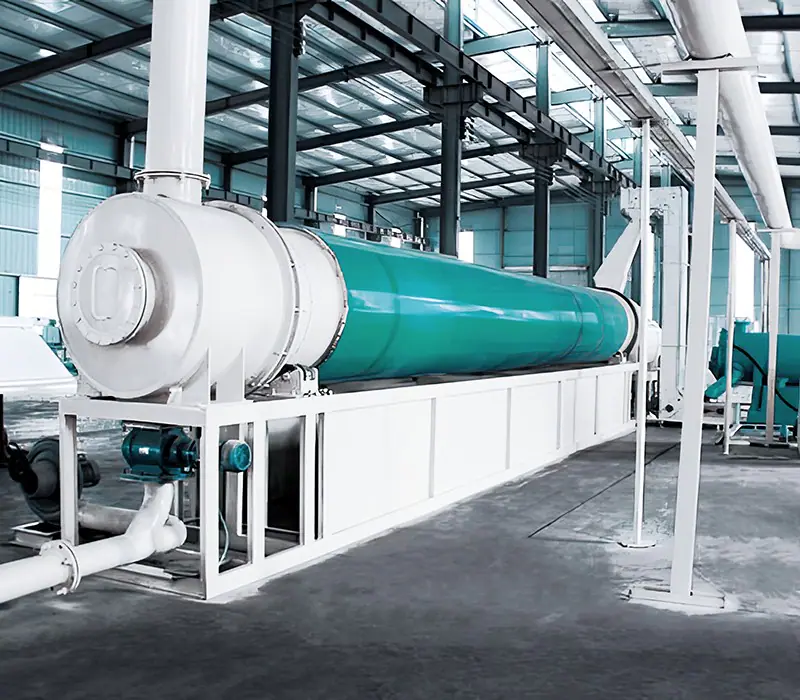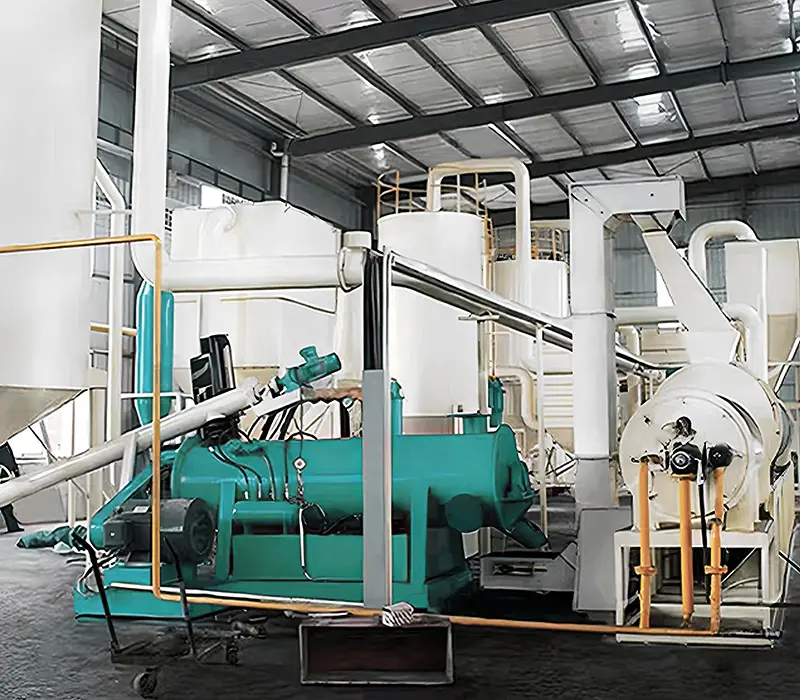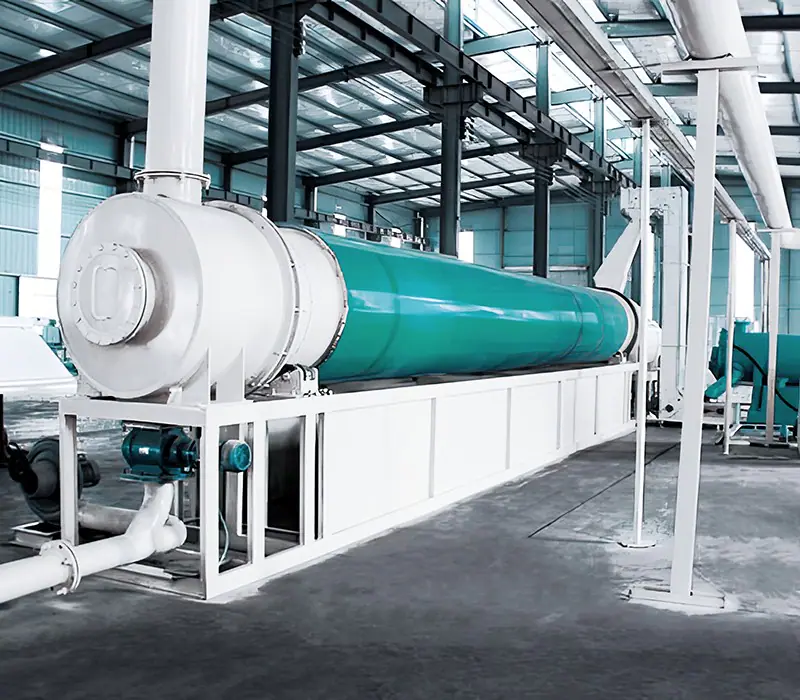
This line processes pyrolysis carbonaceous residue through separation, grinding and optional modification, pelletizing and drying. Equipment selection is not a guarantee of high-purity carbon black or suitability for every rubber, plastic or pigment application. Assess feed composition, ash, moisture and contaminants; then verify the processed material in the intended formulation and replacement ratio. Grinding and pelletizing alone do not establish purity, reinforcement or customer acceptance.
How Recovered Carbon Black Processing Works
- Steel wire separation - Select separation equipment for the steel wire and other contaminants actually present. Confirm separation results by sampling; this step does not by itself establish carbon black purity.
- Grinding - Grinding and classification target an agreed particle-size distribution. Confirm throughput and fineness with representative feed; particle shape alone does not demonstrate improved rubber strength.
- Modification - Use modification only where trials support the proposed additive, dose and application. Verify dispersion, curing and mechanical performance in the customer's formulation; no universal additive recipe is specified here.
- Granulation - Pelletizing can be configured for handling requirements. Establish liquid addition, pellet size, strength and dust generation through trials; pellets are not automatically dust-free.
- Drying - Select drying conditions for the material and pellet formulation. Verify final moisture and safe operating limits; this page does not specify a universal temperature or moisture guarantee.
- Packaging - Agree packaging format and bag weight with the receiver, considering material handling and dust control. Confirm the supplied packaging equipment in the quotation.
Model and Specifications
| Item | RCB-1 |
|---|---|
| Capacity | 1 t/h (1000 kg/h) |
| Raw material | Pyrolysis carbon black, 40 mesh |
| Product granularity | D90 = 325 mesh |
| Working power | 195 kW |
| Power supply | 380 V, 50 Hz, three-phase + ground |
| Dust emission | Project-specific: confirm the test method, reference conditions, measured result and applicable limit. |
| Shipping | 7×40' HQ |
| Gross weight | 12 t |
| Floor space | 1200 m² |
| Dimension | Depending on the specific situation |
Specification note: RCB-1 and the retained capacity, power, dimensions and logistics values are legacy supplier-listed data, not independently verified test results. Confirm configuration and contractual values for the actual feed. Particle size and output require trials; application performance requires formulation tests. No verified emissions test conditions are supplied on this page.
Outputs and application qualification
- Processed rCB powder: agree particle-size and composition requirements, then assess suitability with the intended receiver.
- Pellets: qualify handling, pellet strength, moisture and dust generation for the selected logistics and mixing process.
- Modified material: retain only treatments supported by trials in the intended formulation and replacement ratio.
Key Equipment Features
- Compact, hygienic design - low-profile build with a seamless interior for quick cleaning and grade changeover.
- Feed-dependent material handling - Assess adhesion and discharge with representative feed and the selected configuration. The equipment description is not a no-blockage guarantee.
- The legacy page lists 40-2000 mesh and D90 = 325 mesh. These are not interchangeable test definitions or guarantees at every throughput; agree the measurement method and confirm the target distribution by trials.
- Fully automated control - PLC plus touchscreen with alarms, monitoring current, voltage, temperature and pressure.
- Select separation equipment for the steel wire and other contaminants actually present. Confirm separation results by sampling; this step does not by itself establish carbon black purity.
- Confirm the required dust collection and workplace controls for the material and site. Listed filters or separators do not by themselves establish emissions compliance or safe operation.
Frequently Asked Questions
- What is the difference between crude carbon black and recovered carbon black? Raw pyrolysis residue and processed rCB are not automatically equivalent in application. Rubber, plastic and pigment use depends on composition, ash, contaminants, dispersion and the customer's formulation tests; the equipment name is not an application-grade certificate.
- What is the output particle size? The legacy page lists 40-2000 mesh and D90 = 325 mesh. These are not interchangeable test definitions or guarantees at every throughput; agree the measurement method and confirm the target distribution by trials.
- What is the delivery time? The delivery schedule and departure port are confirmed in the commercial quotation.
- What is the payment method? Mainly T/T; other methods on request.
- Are you a factory or a trading company? We operate our own factory in Shangqiu City, Henan Province.
- Do you support OEM/ODM? Yes, we support OEM and ODM.
- What is the warranty? About 1 year (negotiable), with on-site installation support and engineers available after commissioning.
- What information do I need for a quote? Raw materials, daily processing capacity and project location.
Get a Configuration Quote
Provide representative feed analysis, target particle-size method, required throughput, intended application and acceptance tests so the grinding, separation and optional pelletizing configuration can be assessed.
Equipment and project images