
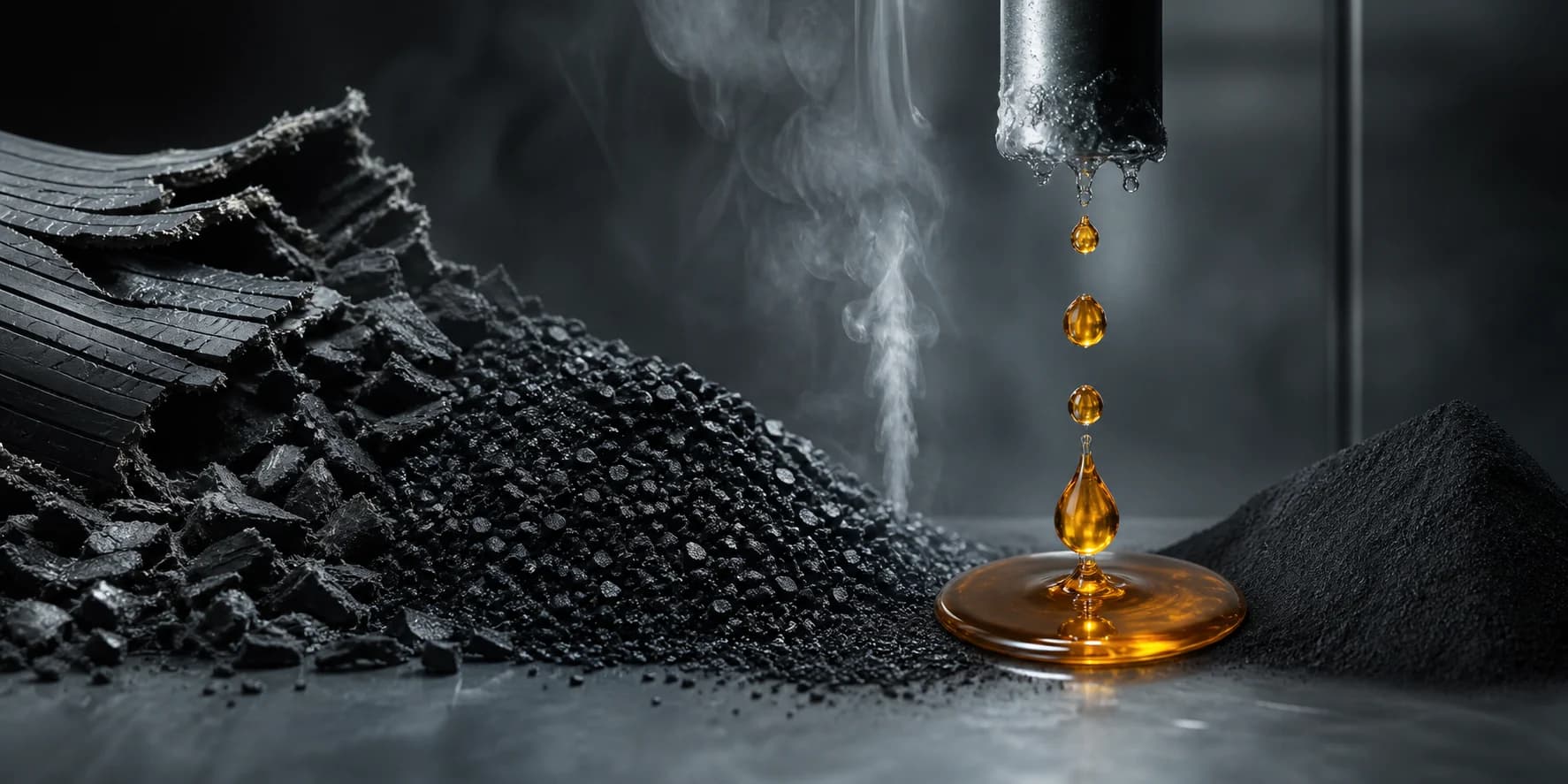
A tyre pyrolysis plant should be evaluated as a complete waste-treatment and product-handling system. Output yield, product value, emissions performance and project return cannot be guaranteed from a tyre name or reactor capacity alone.
What tyre pyrolysis does-and what it does not prove
Pyrolysis heats prepared end-of-life tyres in a controlled, oxygen-limited environment. The tyre polymers decompose into vapours, non-condensable gas and a carbonaceous solid, while embedded steel is recovered from the solids stream. That process description does not establish that every stream is a saleable product, that a proposed use is permitted, or that one plant will reproduce a result reported for another feed and operating window.
Define the feed and sampling plan before equipment sizing
“Waste tyres” is not a complete feed specification. Passenger, truck and off-road tyres, bead content, retained dirt, water and preparation method can change handling, heat demand and product properties. A representative sampling plan should cover normal supply and expected variation, not only a clean demonstration sample.
| Project input | Why it matters | Evidence to record |
|---|---|---|
| Tyre sources and mix | Construction and compounding vary by tyre category and supplier. | Supply records, category shares and seasonal variation. |
| Size and steel preparation | Feeding, heat transfer and discharge depend on the selected preparation route. | Size distribution, bead or wire-removal scope and preparation mass balance. |
| Moisture, dirt and foreign material | They affect useful heat, residues, corrosion risk and unaccounted mass. | Representative analysis, rejection limits and receiving inspection. |
| Target products and users | A product name does not define an acceptance specification. | Buyer test methods, storage limits and an off-spec route. |
How a tyre pyrolysis line works
The commercial plant boundary is wider than the reactor. A project review should follow material and energy through every connected stage:
- Receive, identify and sample the tyre feed; separate prohibited or uncontrolled material.
- Shred, cut, de-bead, dry or blend only as required by the chosen feeding and reactor design.
- Meter the prepared feed into a sealed system and control air ingress.
- Manage temperature, pressure, residence conditions and heat input inside the tested operating window.
- Remove entrained solids, condense recoverable vapours and collect liquid fractions under defined conditions.
- Measure and safely route non-condensable gas; define combustion, treatment and emergency handling.
- Cool, contain, sample and route the carbonaceous solid, steel, water, residues and off-spec material.
Products are specifications, not guaranteed labels
Research reviews consistently show that feed properties, reactor configuration and operating conditions influence product distribution and quality. The project therefore needs a test package for each stream before revenue is assigned.
| Stream | Do not assume | Evidence needed before value is assigned |
|---|---|---|
| Condensed liquid | That all liquid is a drop-in road fuel or has a fixed heating value. | Composition, water, sulfur, solids, distillation range, stability and intended-user trials. |
| Carbonaceous solid | That raw char is automatically recovered carbon black or a named reinforcing grade. | Ash, sulfur, volatiles, particle properties, wire/fabric removal, upgrading steps and application testing. |
| Recovered steel | That all separated metal meets a recycler's cleanliness specification. | Mass, contamination, handling form and recycler acceptance. |
| Non-condensable gas | That all gas can be reused or makes the line energy self-sufficient. | Flow, composition, calorific value, pressure stability, treatment, burner limits and flare or safe-disposal route. |
How to discuss yield without making an unsupported promise
A defensible yield statement identifies the feed sample, preparation, reactor, operating conditions, sampling points, test methods and reporting basis. It should show liquids, gas, solids, steel, water, rejects and unaccounted loss in one closed mass balance. Wet-basis and dry-basis figures must not be mixed.
For procurement, use a representative feed trial and agree an acceptance-test protocol. State the allowable feed window, steady-state period, measurement instruments, sample frequency, laboratory methods, reconciliation tolerance and treatment of start-up, shutdown and off-spec material. Reference-plant data can inform a test plan; it is not a guarantee for a different project.
Emissions and permitting are site-specific boundaries
An oxygen-limited reactor does not mean a site has no emissions. Review receiving and storage, feed preparation, seals, vapour handling, combustion devices, flue gas, wastewater, odors, noise, solid residues, product tanks, start-up, shutdown and abnormal operation. The control train and monitoring plan must match the actual feed, process and permit.
Waste status, product status and downstream combustion are legal questions for the project jurisdiction. EU Industrial Emissions Directive Article 42, as amended, illustrates that treatment and later combustion conditions can change the regulatory boundary. It does not grant automatic approval to a tyre pyrolysis plant. Confirm the current local route with the competent authority before equipment commitments.
Build project economics from scenarios, not a fixed payback claim
Model contracted feed volume, receiving and preparation losses, operating calendar, tested product acceptance, off-spec handling, utilities, labor, maintenance, consumables, residue disposal, transport, taxes and financing on one defined battery limit. Separate gate fees from product revenue and document who bears each cost.
Use conservative, base and upside cases, then stress-test feed availability, plant utilization, product rejection, selling price, energy cost and maintenance downtime. A supplier can provide engineering inputs, but the owner and its advisers must validate local contracts, taxes, permits and financing. No generic daily revenue or payback period is transferable across projects.
Batch or continuous: choose from the operating plan
A batch route may fit campaign-based supply or operations that benefit from clear charge boundaries. A continuous route may fit stable, prepared feed and longer coordinated campaigns. Neither label proves better yield, lower energy use or lower cost.
Compare the complete preparation, feeding, reactor, condensation, gas treatment, solids handling, controls, staffing and maintenance scope. Ask how availability is defined and which events-planned maintenance, feed shortages, downstream stops or utility loss-are excluded.
Evidence to request before procurement
- Feed acceptance envelope, representative analyses and sampling method.
- Process flow diagram, equipment list, battery limits and material routes.
- Project-specific mass and energy balance with assumptions and unaccounted loss.
- Product test methods, buyer specifications, storage limits and off-spec destination.
- Emissions inventory, control scope, monitoring points, wastewater and residue routes.
- Start-up, normal-operation, shutdown, emergency and maintenance procedures.
- Reference evidence for comparable feed and configuration, with differences disclosed.
- Acceptance-test protocol, responsibilities, warranties, exclusions and correction plan.
Continue the project screen
Compare the batch tyre pyrolysis plant and continuous tyre pyrolysis plant, then send representative feed data, intended product uses and site conditions through the project enquiry form. A useful quotation starts from evidence, not a universal yield table. Submit project evidence.
Technical and regulatory reference basis
These sources support the evidence boundaries used in this guide:
- ASTM D8632-26: Standard Classification for Recovered Carbon Black-rCB Used in Rubber Products
- Energy & Fuels review: Waste tyre pyrolysis products and influencing conditions
- Energies review: Influence of feed and process conditions on tyre pyrolysis
- Energy & Fuels review: Tyre pyrolysis oil properties and upgrading constraints
- EUR-Lex: consolidated Industrial Emissions Directive, including amended Article 42
The sources describe standards, research findings and one regulatory framework. They do not certify a Pyrojin design or predict a project result. Feed testing, site engineering, buyer qualification and local approval remain required.