Project Details
- Project Location
- Longnan, Gansu Province, western China (Qinling-Daba mountainous region)
- Configuration
- Two batch-type horizontal rotary pyrolysis units (12 TPD design capacity each)
- Combined Design Capacity
- 24 TPD (design)
- Feedstock
- Waste tires
- Project Year
- 2018
- Original Project Status
- Delivered and commissioned in 2018; documented by installation and commissioning photographs in the project archive
- Current Operating Status
- Not independently verified
- Supplier
- Shangqiu Jinpeng Industrial Co., Ltd. (PYROJIN)
Every pyrolysis plant is sized twice: once by its reactors and once by the roads that lead to it. In the steep country of southern Gansu, where Longnan sits at the seam of the Qinling and Daba mountain systems, the second sizing can dominate. The project recorded here - two batch-type units with a combined design capacity of 24 tonnes of waste tires per day - was configured around that reality: equipment that could be moved into a mountain valley in stages, and a scale matched to what a local catchment could realistically supply. Its transport plan, intake, and scale were designed as one system.
Project Background & Configuration Logic
Longnan occupies the southern edge of Gansu, where the Qinling range meets the Daba mountain system. Terrain is a sequence of narrow valleys and steep ridges; roads follow river courses and climb passes, leaving little room for wide layouts or heavy single-piece loads. The climate is wetter and milder than the rest of the province, which matters for feedstock storage and seasonal road access.
The feedstock logic mirrors the transport logic. There is no tire-manufacturing cluster in the immediate region; waste tires accumulate from vehicle servicing, haulage fleets, and agricultural machinery - a scattered but steady local stream. A larger plant would have had to import tires over long mountain hauls, adding transport cost to every tonne before the reactor fired. Two units kept the plant in step with what a local catchment could deliver, trading headline capacity for intake realism.
The configuration was designed accordingly: batch-type horizontal rotary units in the 12 TPD class, a production model that tolerates variable intake cadence better than a flow-through line does, and a footprint sized for valley-floor conditions. Installation guidance and operator training were part of the delivery scope. Two units rather than one also gave operating resilience: one line can be maintained while the other continues its cycle, and schedules can extend activity across the day without any reactor running beyond its batch cycle.
Core Technology & Production Analysis
Moving the Plant In: Equipment Transport in Mountain Terrain
A batch line of this class involves roughly 60 tonnes of installed equipment per unit - ordinary logistics on flat ground, the defining constraint in mountain country. Equipment is delivered in transportable sub-assemblies and joined on site, so no single load exceeds what the road will carry; foundation and lifting work is planned around the space available on a valley-floor site. Modest scale thus functions as a transport strategy: two smaller units are easier to move and assemble in stages than one large line.
Catchment-Sized Intake and Feedstock Preparation
With the catchment sized to match two units, intake planning stays simple: tires arrive from local collection points, are held in storage, and are loaded in batches through the reactor's feed door - whole or cut, depending on size. Because the site's appetite is deliberately modest, storage needs stay bounded; the wetter mountain climate makes covered storage a sensible part of the layout.
Two-Line Batch Rotation
A typical batch cycle on this equipment class runs in the order of 22-24 hours: about two hours of loading, four of preheating, ten of active pyrolysis, four to six of cooling, two of discharge. With two units, cycles can be staggered so one reactor is in its heating phase while the other cools, discharges, or is reloaded. The site keeps productive activity going across the day without any unit leaving its batch rhythm, and one or two operators per installation suffice because the work is sequenced, not simultaneous.
Reactor, Heating, and Process Conditions
The reactors are horizontal rotary vessels in Q345R boiler steel, rotating slowly - about 0.4 revolutions per minute - so the tire material tumbles and exposes fresh surface to heat. Heating is indirect: the material never comes into contact with the flame. The vessel operates at low pressure under inert, anaerobic conditions, with a slight negative pressure held inside. This combination gives controlled thermal decomposition - consistent conditions across the batch, with the vapor side of the process contained.
Vapor Handling: Condensation and Gas Return
Vapors released during the pyrolysis phase are drawn into the condensation system, where the condensable fraction collects as pyrolysis oil - a fuel oil, not diesel; reaching diesel-grade fuel would require further refining, hydrotreating, and certification testing. The non-condensable gas fraction may be returned to the heating system where the installed design and operating conditions permit, reducing external fuel demand. Flue gas from the heating system passes through the installed treatment train - an alkali spray tower followed by an adsorption tower for desulfurization and dedusting - designed so that discharge is subject to local emission requirements under proper operating conditions.
Solid Outputs and Product Boundaries
After the cycle, the reactor is emptied of its solid fraction and the steel wire tires contain. The solid fraction is recovered carbonaceous material; any higher-value market depends on testing and further processing, and it should not be described as commercial-grade carbon black without that evidence. The steel wire is a clean, saleable scrap stream. Yields of oil, solid, and gas vary with tire type and composition; no fixed figures are claimed for this project.

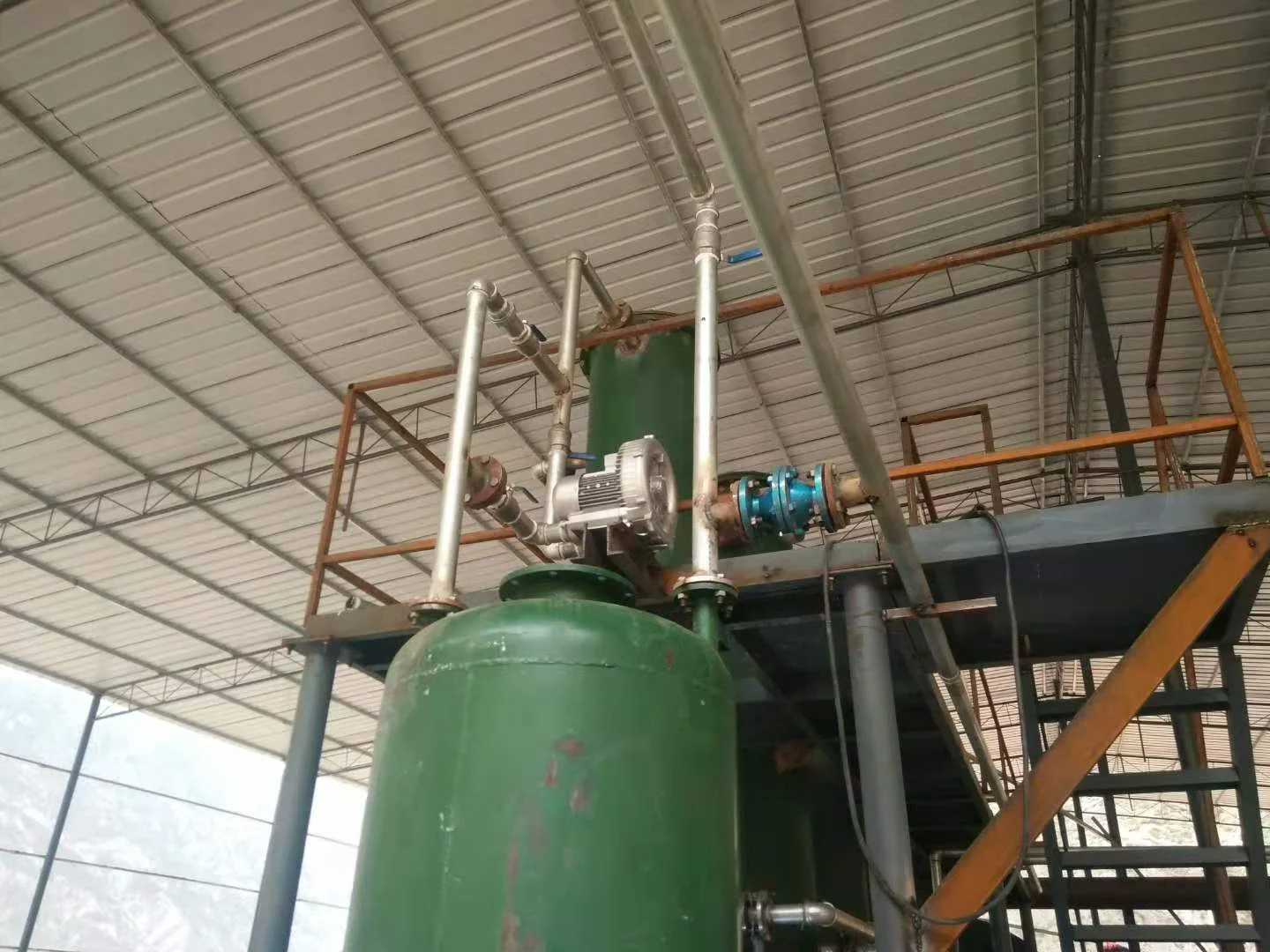
Overall site view of the two-unit batch waste tire pyrolysis plant at Longnan, Gansu, 2018, showing the layout in its mountain-valley setting. Photo taken during installation and commissioning in 2018.

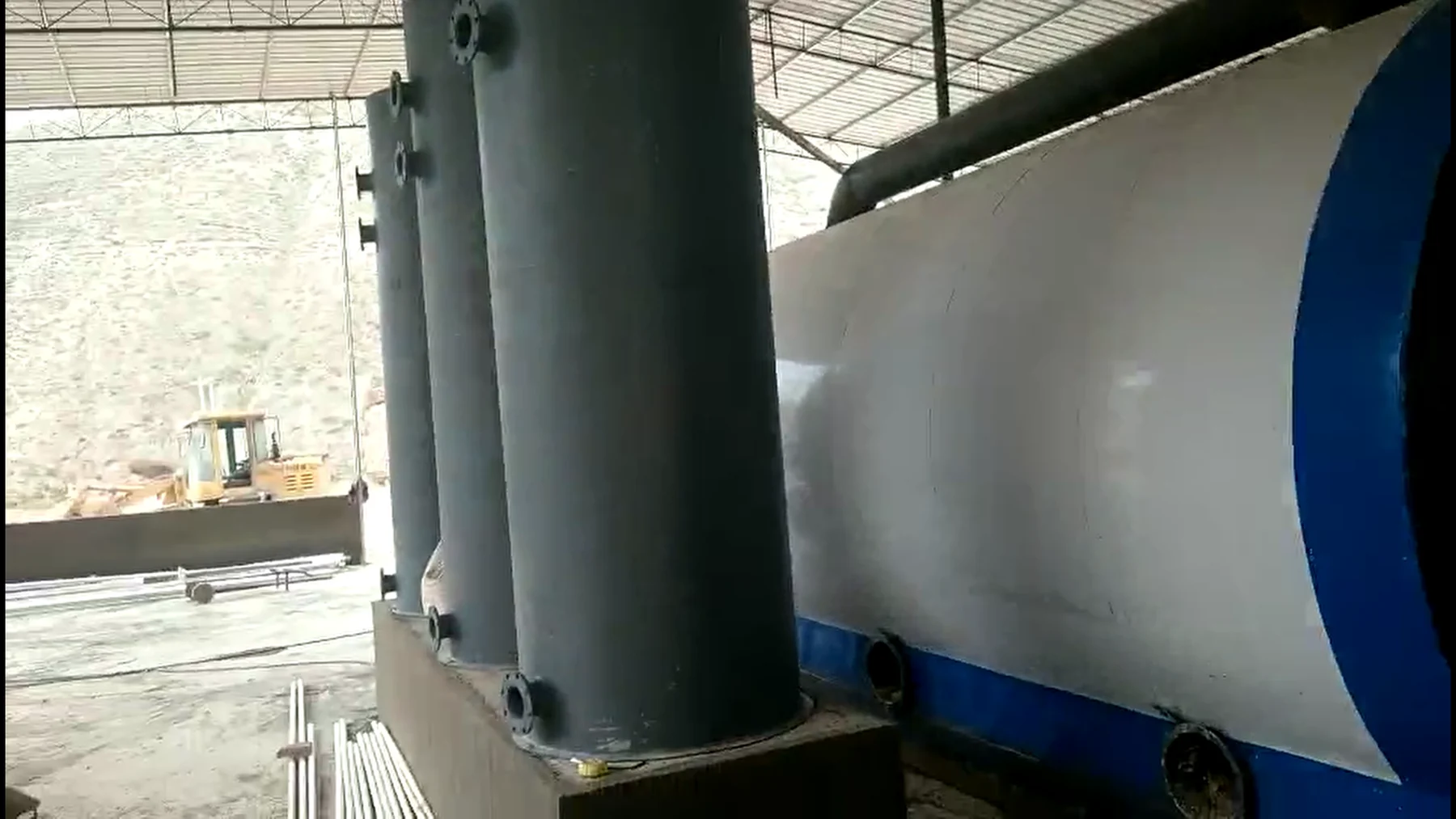
Process detail of the reactor feed end and loading arrangement at the Longnan, Gansu plant, 2018. Photo taken during installation and commissioning in 2018.
Project Specifications
| Item | Project specification |
|---|---|
| Location | Longnan, Gansu Province, China (Qinling-Daba mountainous region) |
| Project year | 2018 |
| Status | Historical archive project; delivery and commissioning documented by photographs |
| Feedstock | Waste tires |
| System | Batch-type horizontal rotary pyrolysis |
| Number of units | 2 |
| Capacity per unit | 12 TPD (design capacity) |
| Combined design capacity | 24 TPD |
| Production model | Batch, two-unit rotation |
| Main recovered streams | Pyrolysis oil (fuel oil), recovered carbonaceous material, steel wire; non-condensable gas may be returned to the heating system where the installed design and operating conditions permit |
| Supplier | Shangqiu Jinpeng Industrial Co., Ltd. (PYROJIN) |
What the Project Demonstrates
This project shows that a batch pyrolysis plant can be matched to a difficult geography rather than imposed on it. The transport plan - sub-assemblies, staged assembly, valley-floor layout - shows how this equipment class is handled where roads are the limiting factor. The scale decision shows the more important discipline: sizing capacity to what a local catchment can actually deliver - the calculation any remote-region client should repeat. Two-unit batch rotation shows how a small site stays productive through scheduling and a small crew.
For clients evaluating similar projects, the points to examine are the ones this plant was built around: equipment access and transport, covered storage and seasonal road conditions for the feedstock, and a realistic estimate of monthly tire generation in the catchment. A two-unit batch plant is a workable entry configuration because it leaves room to grow - adding lines later - without betting the site on feedstock volume that does not exist.
About Jinpeng
Shangqiu Jinpeng Industrial Co., Ltd. designs and manufactures batch, semi-continuous, and continuous pyrolysis plants, oil distillation systems, and supporting equipment for waste tires, waste plastics, oil sludge, rubber-derived materials, and other suitable carbon-rich feedstocks. Project configuration is developed around material characteristics, production objectives, site conditions, and applicable local requirements. For project discussions, visit www.pyrolysis-machine.com.
Disclaimer & Archive Note
All capacities in this document are design values; actual throughput depends on feedstock characteristics, loading practice, and operating conditions. Recovered product quantities and properties (pyrolysis oil, recovered carbonaceous material, steel wire) depend on the feedstock processed and require testing for any specific end use; pyrolysis oil is a fuel oil and is not diesel, and reaching diesel-grade fuel requires further refining, hydrotreating, and certification testing. Energy and emissions performance depend on the auxiliary systems installed and on actual operation, and any final design must comply with applicable local regulations.
Archive Note: This retrospective is based on Jinpeng's project records and photographs from the original delivery and commissioning period. It describes the documented project configuration and does not constitute verification of the plant's current operating status.