
Quatre unités de 12 TPD pour un deuxième opérateur dans la même ville et la même année - un signal de maturité du marché autant qu'une configuration de machine.
Détails du projet
- Emplacement du projet
- Puyang, province du Henan, Chine
- Configuration
- 4 × 12 unités de pyrolyse horizontale par lot (série XY-8-P/PB)
- Capacité de conception combinée
- 48 TPD (4 unités × 12 TPD capacité de conception par unité)
- Matière première
- Pneumatiques usagés (entiers ou coupés, chargés par lots)
- Année du projet
- 2018
- Statut initial du projet
- Livré et mis en service en 2018; photographies de l'installation conservées dans les archives du projet Jinpeng
- Statut de fonctionnement actuel
- Non vérifié de manière indépendante
- Fournisseur
- Shangqiu Jinpeng Industrial Co., Ltd. (PYROJIN)
Une ville avec de la place pour deux usines
La première question habituelle est de savoir si une ville produit suffisamment de pneus usagés pour une seule usine. La question plus révélatrice - celle autour de laquelle cette entrée d'archive est construite - est de savoir s'il y en a assez pour deux. Puyang, une ville de l'industrie pétrolière dans le nord-est du Henan, a répondu par 2018: les archives de Jinpeng enregistrent deux livraisons dans la même ville cette année-là - une installation de six unités pour un opérateur, et l'usine de quatre unités, 48 TPD documentée ici pour un deuxième. Une deuxième usine dans un même bassin n'a de sens que lorsque la première a montré que le stock d'alimentation pouvait être collecté et le produit vendu.
Contexte du projet et logique de configuration
Puyang, à la jonction du Henan, du Shandong et du Hebei et liée à la région pétrolière de Zhongyuan, génère un flux constant de pneus de camion et de passagers par le biais des activités de fret. Dès 2018, la ville hébergeait déjà une installation par lots de six unités de Jinpeng; les canaux de collecte pour les pneus usagés, les acheteurs de fuel oil et de matériaux carbonés récupérés, ainsi qu'un précédent d'implantation existaient tous. Un deuxième opérateur n'avait pas besoin de construire un marché à partir de zéro; le travail consistait à dimensionner, à gérer la concurrence et à opérer.
Quatre unités - 48 TPD capacité de conception combinée - se situent entre un point d’entrée de deux unités (24 TPD) et l’installation de six unités (72 TPD) qui les précédait. La configuration partage l’infrastructure de soutien entre les quatre réacteurs: stockage des matières premières, réservoirs de produits et système de traitement des gaz de combustion, dimensionné une fois pour chaque conduite. Quatre unités se divisent également en deux paires - une rotation fonctionnelle sans la charge de planification d’un plus grand nombre de lignes, et une forme raisonnable pour un second opérateur partageant les pneus de la ville avec un opérateur établi.
Technologie Principale & Analyse de Production
Ce qu’une seconde centrale dans une ville signale
Une seconde usine de pyrolyse dans le même bassin versant n’est exploitable qu’une fois les fondamentaux prouvés. La collecte n’a pas besoin d’être inventée: les ferrailleurs, flottes de camions, dépôts de bus et ateliers de pneus orientent déjà les pneus usagés vers les transformateurs; une nouvelle plante est en concurrence à l’intérieur de ces canaux. La décharge est également démontrée - la présence continue du premier exploitant implique des acheteurs locaux pour le fioul, les matériaux carbonés récupérés et les fils d’acier. Interprétée comme un signal de marché, l’usine de quatre unités suggère que les montages de pneus de la ville étaient suffisants pour deux installations - une déduction tirée des archives, et non une déclaration sur les résultats de l’une ou l’autre des centrales.
Quatre unités en configuration de bande intermédiaire
La capacité de conception combinée de 48 TPD se situe entre une configuration d'entrée à deux unités et l'installation de six unités livrée la même année. Pour un second opérateur sur un marché concurrentiel, quatre unités équilibrent le débit par rapport au risque lié aux matières premières: une capacité suffisante pour justifier des utilités partagées et une ligne de traitement appropriée, mais pas au point que le site dépende de gagner la majorité des pneus de la ville. Les quatre réacteurs sont des unités de lot XY-8-P/PB identiques d'une capacité de conception de 12 TPD, disposés autour d'une zone de processus avec de la place pour des unités supplémentaires ultérieures.
Rotation par lots sur quatre lignes
Chaque unité de lot suit un cycle d'environ 22-24 heures: chargement, préchauffage, pyrolyse, refroidissement et déchargement. L'étalement des cycles signifie que deux lignes peuvent être en phase de pyrolyse pendant qu'une troisième se refroidit et qu'une quatrième est chargée ou déchargée. L'avantage n'est pas un débit plus élevé mais une demande plus linéaire sur la main-d'œuvre et la logistique: l'entrée est répartie par lots pour correspondre au moment où un réacteur est prêt, et le produit quitte le parc de réservoirs de manière régulière. Les directives de conception pour cette catégorie supposent un à deux opérateurs; les cycles décalés rendent cela réaliste.
Concurrence pour les matières premières et planification des approvisionnements
Deux usines dans une même ville planifient l'apport différemment d'un opérateur isolé. L'étendue des sources est importante: les pneus de voitures particulières et de camions diffèrent par leur masse, leur fil métallique et leur composition, et l'acceptation de pneus entiers ou coupés élargit le pool de fournisseurs. La conception par lots est utile: chaque unité de 12 TPD reçoit sa charge en une seule opération de chargement au début d'un cycle, de sorte que les pneus s'accumulent dans le stockage et que les réacteurs sont chargés lorsque l'approvisionnement s'est constitué, et non à partir d'un flux continu entrant. Le tampon de stockage est la réponse pratique à la concurrence sur les matières premières - lorsque les modèles de collecte changent, un parc stocké gagne du temps.
Flux de produits et leurs limites
Les flux récupérés sont le pétrole de pyrolyse, le matériau carboné récupéré, le fil d'acier et le gaz non condensable - et il est important de les nommer précisément. Le pétrole est un flux de fuel-oil; une spécification diesel telle que EN590 nécessiterait une distillation supplémentaire, un hydrodésulfurage et des tests de certification. Le solide est du matériau carboné récupéré, et non du noir de carbone commercial à moins qu'il ne soit profondément traité et testé comme tel. Le gaz non condensable peut être réinjecté dans le système de chauffage lorsque la conception installée et les conditions d'exploitation le permettent. Dans une ville à deux usines, le marché de ces flux est partagé - une raison de plus pour laquelle l'échelle modérée, le stockage et la rotation régulière sont importants.
Traitement des émissions sous contrôle partagé
Une ville accueillant déjà une centrale de pyrolyse dispose d'un point de référence pour la deuxième. La conception de traitement installée pour cette classe d'usine est un système fermé à micro-dépression dans lequel les gaz de combustion passent à travers une tour de pulvérisation (neutralisation alcaline) et une tour d'adsorption (désulfuration et dépoussiérage), conçu pour respecter les exigences locales d'émission applicables. Dans des conditions de fonctionnement appropriées et après le système de traitement installé, les performances environnementales dépendent des équipements auxiliaires et de leur mode de fonctionnement - le contrôle clé dans une ville à deux usines est de savoir si la ligne de traitement est dimensionnée pour la charge nominale complète de 48 TPD.
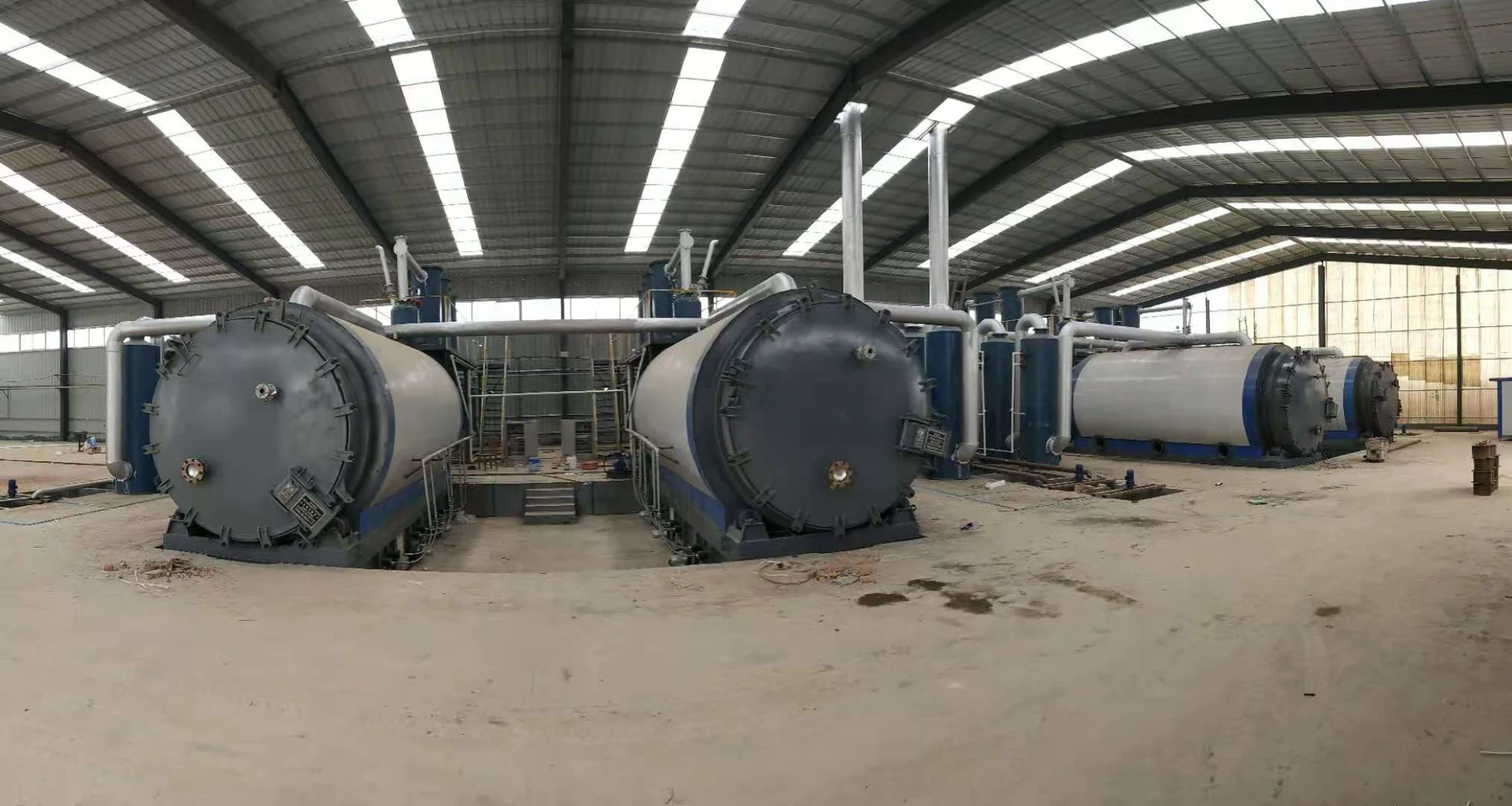
Vue d'ensemble du site de pyrolyse de pneus par lots à quatre unités à Puyang, Henan, montrant les lignes de réacteurs et la zone de processus partagée. Photo prise lors de l'installation et de la mise en service en 2018.
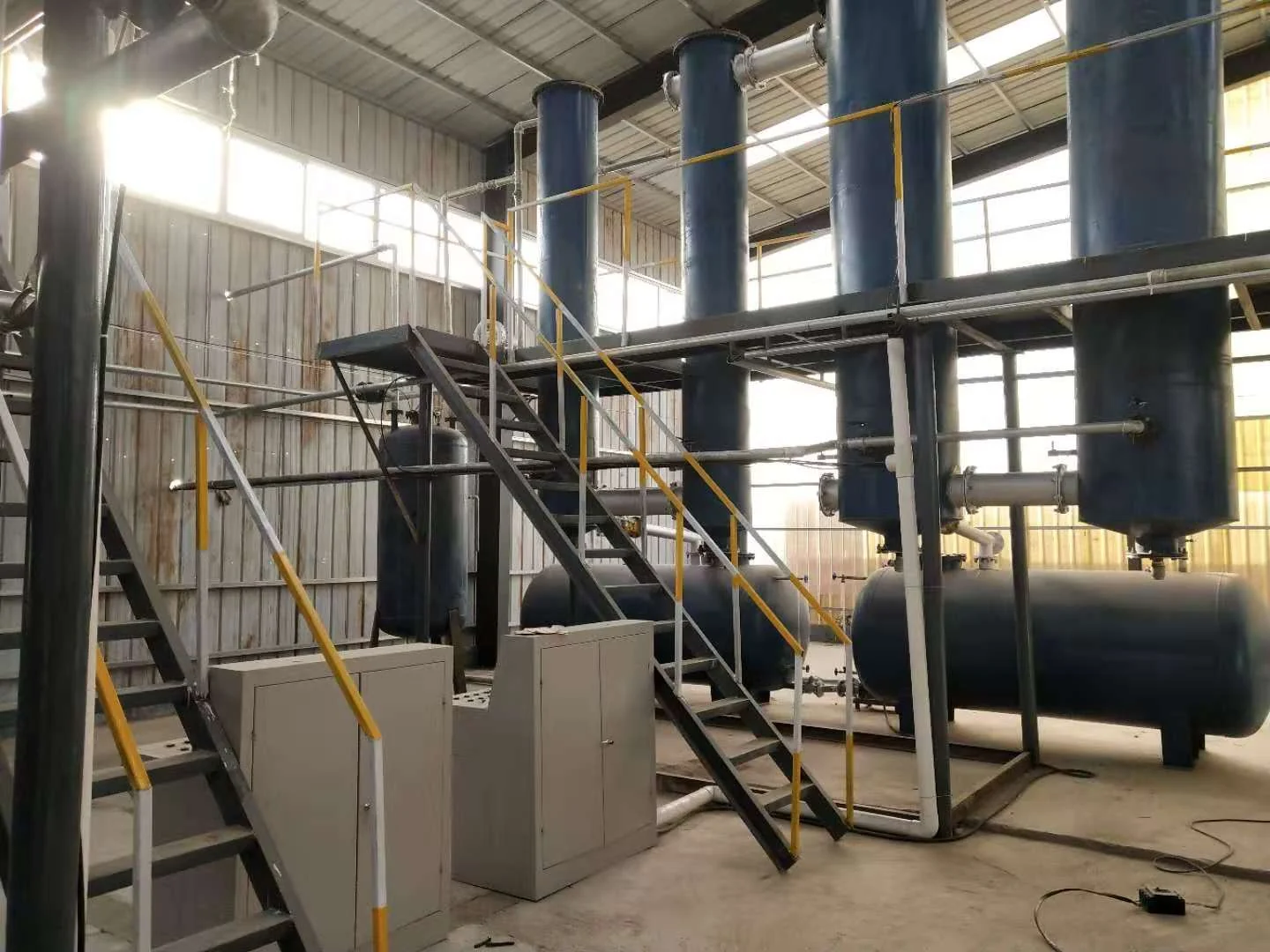
Détail du processus du projet de Puyang: réacteur et zone de condensation pendant l'installation. Photo prise lors de l'installation et de la mise en service en 2018.
Spécifications du projet
| Article | Spécification du projet |
|---|---|
| Emplacement | Puyang, province du Henan, Chine |
| Année du projet | 2018 |
| Statut | Projet d'archives historiques; livré et mis en service en 2018; état de fonctionnement actuel non vérifié indépendamment |
| Matière première | Pneumatiques usagés (entiers ou coupés, chargés par lots) |
| Système | Pyrolyse rotative horizontale par lots (série XY-8-P/PB), chauffage indirect, micro-dépression |
| Nombre d'unités | 4 |
| Capacité par unité | 12 TPD (capacité de conception) |
| Capacité nominale combinée | 48 TPD (capacité nominale) |
| Modèle de production | Lot, cycles multi-lignes décalés (≈22-24 h par cycle référence de conception) |
| Principaux flux récupérés | Huile de pyrolyse (mazout), matériau carboné récupéré, fil d'acier; le gaz non condensable peut être renvoyé au système de chauffage lorsque la conception installée et les conditions de fonctionnement le permettent |
| Fournisseur | Shangqiu Jinpeng Industrial Co., Ltd. (PYROJIN) |
Ce que le projet démontre
Ce projet démontre qu'une configuration par lots Jinpeng peut être reproduite au sein d'une même ville - un deuxième opérateur dans un bassin mature est supportable. Pour un acheteur dont la ville accueille déjà un opérateur de pyrolyse, la valeur est concrète: une deuxième usine dimensionnée pour partager un marché plutôt que le monopoliser - quatre unités, services publics partagés, rotation décalée et un tampon de stockage comme réponse à la concurrence de matières premières. Les évaluateurs doivent observer trois éléments: l'approvisionnement en entrée selon les types de pneus et les fournisseurs; la vente commune des produits à un prix approprié; et une ligne de traitement dimensionnée pour la charge de conception combinée totale. Le projet ne prouve pas les résultats opérationnels actuels - aucune révision récente n'existe - mais il documente une réponse de configuration à un marché compétitif.
À propos de Jinpeng
Shangqiu Jinpeng Industrial Co., Ltd. conçoit et fabrique des usines de pyrolyse par lots, semi-continues et continues, des systèmes de distillation d'huile, et des équipements de soutien pour pneus usagés, plastiques usagés, boues pétrolières, matériaux dérivés du caoutchouc et d'autres matières premières riches en carbone appropriées. La configuration du projet est développée en fonction des caractéristiques des matériaux, des objectifs de production, des conditions du site et des exigences locales applicables. Pour des discussions sur les projets, visitez www.pyrolysis-machine.com.
Avertissement
Toutes les capacités indiquées dans cet article sont des capacités de conception, et non des rendements garantis. Le débit réel dépend des caractéristiques des matières premières et des conditions d'exploitation. Les rendements et les propriétés des produits varient en fonction des matières premières et des paramètres du processus et doivent être déterminés par des tests pour chaque matériau spécifique. Les performances énergétiques et les émissions dépendent des systèmes auxiliaires installés et de la pratique opérationnelle réelle. La conception finale du projet doit être conforme aux réglementations et exigences applicables à l'emplacement du projet.
Note d'archive: Cette rétrospective est basée sur les dossiers de projet et les photographies de Jinpeng provenant de la période de livraison et de mise en service initiale. Elle décrit la configuration documentée du projet et ne constitue pas une vérification de l'état de fonctionnement actuel de l'usine.