Four batch lines, each with a 12 TPD design capacity, configured around a county-scale tire catchment - with staggered cycles setting the site's staffing and operating rhythm.
Project Details
- Project Location
- Chibi, Hubei, China
- Configuration
- 4 × XY-8-P/PB batch horizontal rotary pyrolysis plants (Φ2800×8800 reactor class)
- Combined Design Capacity
- 48 TPD (4 units × 12 TPD design)
- Feedstock
- Waste tires (whole or cut)
- Project Year
- 2018
- Original Project Status
- Delivered and commissioned in 2018
- Current Operating Status
- Not independently verified
- Supplier
- Shangqiu Jinpeng Industrial Co., Ltd. (brand PYROJIN)
Opening
Chibi is a county-level city, and its waste-tire problem is county-scale: a bounded, slowly renewing stream of passenger and truck tires gathered from local roads, repair shops, and small collectors, rather than the dense industrial flow a major urban center generates. A four-unit batch pyrolysis plant is a configuration that fits this scale naturally. At a combined design capacity of 48 TPD, it is large enough to absorb a county's regular tire arisings in one processing rhythm, and small enough that intake, storage, and staffing stay within reach of a modest operation. The genuinely interesting design problem at this size is not the reactor itself but the cadence: how four batch lines, each running a cycle of roughly a day, are scheduled, fed, and staffed so the site works as one plant rather than four independent machines.
Project Background & Configuration Logic
The configuration was designed around the characteristics of a county-scale catchment. Waste-tire supply at this level arrives irregularly - heavy weeks after vehicle service peaks, quieter weeks in between - and a batch plant tolerates that variability better than a process that must be fed continuously to hold its design point. Four lines at 12 TPD design capacity give the site a practical middle ground: at light intake, one or two lines can carry the week's volume while others stand by; at seasonal peaks, all four can run. The 12 TPD line (Φ2800×8800 reactor class) is Jinpeng's mid-size batch unit, sized for whole or cut tires and operated on a roughly 22-24 hour cycle. Because all four lines share the same reactor class, spares, operating habits, and operator training are common across the site. Installation guidance and operator training were part of the delivery scope, and the layout was arranged so the four lines could share process areas while remaining individually serviceable.
Core Technology & Production Analysis
Sizing to a County-Scale Catchment
A county does not generate enough tires to justify a continuous plant, whose economics depend on steady, high-volume feed. Four batch lines at 48 TPD combined design capacity match the bounded arisings of a county-scale catchment while leaving room for growth: batch plants of this class can be linked in series, and further lines can be added to the same site as intake grows. The practical question for the operator is not peak throughput but whether the site can smooth out intake peaks - which is why tire storage and preparation capacity matter as much as reactor count.
The Staggered Cycle: Rhythm of a Four-Line Site
Each XY-8-P/PB line runs a batch cycle of roughly 22-24 hours: loading around two hours, preheating around four, the main pyrolysis phase around ten, cooling four to six, and discharge about two. If all four lines started together, the site would alternate between idle and frantic. The design logic of a multi-line batch site is staggering: with start times offset, at any given hour one line is loading or discharging while others sit in pyrolysis or cooling. This spreads the heavy manual phases across the day, keeps product flowing in a steadier cadence, and lets shared utilities - cooling water, gas handling, power - see a more even load.
Loading and Feedstock Preparation
Because the loading window is only about two hours per line, prepared feedstock must be waiting when a reactor becomes available. Whole passenger tires can be loaded directly; larger or oversized tires benefit from cutting to fit the reactor mouth and to pack more efficiently. Each line returns to a loading state roughly once a day, and that sets the preparation tempo: cutting and staging can proceed steadily between cycles instead of in a rush, as long as the staging area is sized for at least one full batch ahead.
Crew Structure and the Four-Line Shift
Batch plants of this class are designed for one to two operators per line, but four lines do not require four separate crews, because the cycle phases demand different attention. During preheat and the steady pyrolysis phase, the operator's main tasks are monitoring temperature, pressure, and the micro-negative-pressure condition; loading and discharge are the hands-on windows. With staggered cycles, a small team can concentrate at the line that is loading or discharging while keeping the others under observation. This is the staffing model that makes four-line batch practical at county scale: a handful of trained operators can run the whole site when the schedule is designed around them.
Pyrolysis, Condensation, and Gas Handling
The reactors are heated indirectly - the material does not contact the flame - and operate at low pressure, under inert, anaerobic conditions, with the system held at micro-negative pressure to contain process gas. The reactor shell rotates slowly (0.4 r/min) to expose fresh material and promote even heat transfer. Vapor leaving the reactor passes to the condensation system; the main liquid product is pyrolysis oil, collected and stored as a fuel oil. It is not diesel: reaching diesel-grade fuel requires further distillation, hydrotreating, and certification testing. Non-condensable gas from the process may be returned to the heating system where the installed design and operating conditions permit. Flue gas from the heating side passes through a spray tower with alkaline liquor and an adsorption tower for desulfurization and dedusting - a treatment train designed to meet applicable local emission requirements under proper operating conditions.
Output Streams and Site-Level Logistics
A tire batch line yields three physical outputs plus the gas stream: pyrolysis oil, recovered carbonaceous material, and steel wire. At a county-scale site, the logistics question is where each stream goes. Oil is stored in tanks and dispatched to fuel-oil buyers; steel wire leaves as scrap; recovered carbonaceous material accumulates in bulk and must be managed as a product or intermediate with its own handling and testing requirements - it is not commercial-grade carbon black unless deep-processed and tested. Yields vary with tire type and condition, so storage and dispatch planning should be built around ranges, not fixed numbers.
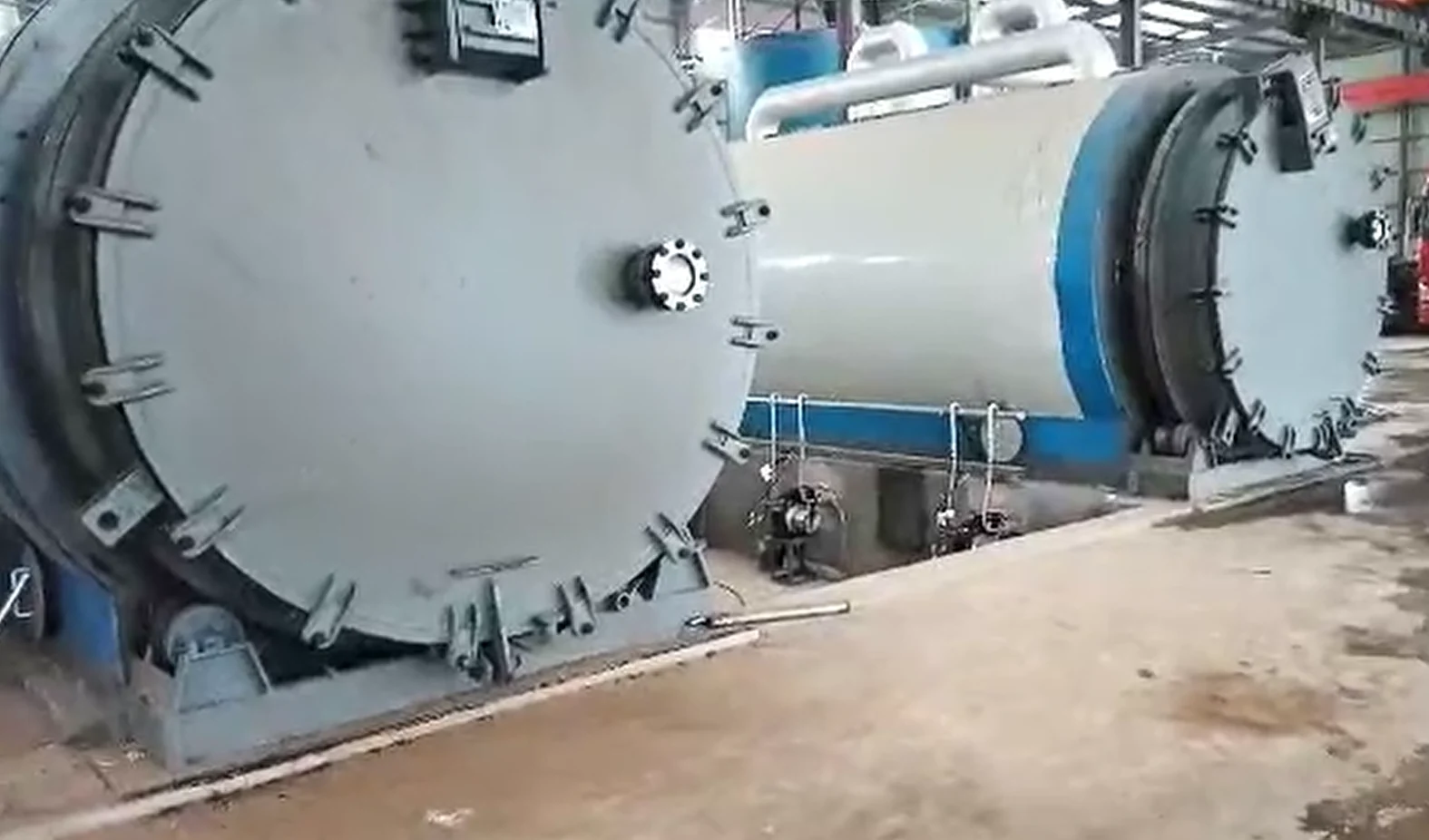
Photo 1

Overall view of the four-unit batch tire pyrolysis plant in Chibi, Hubei, showing the reactor lines and shared process areas. Photo taken during installation and commissioning in 2018.
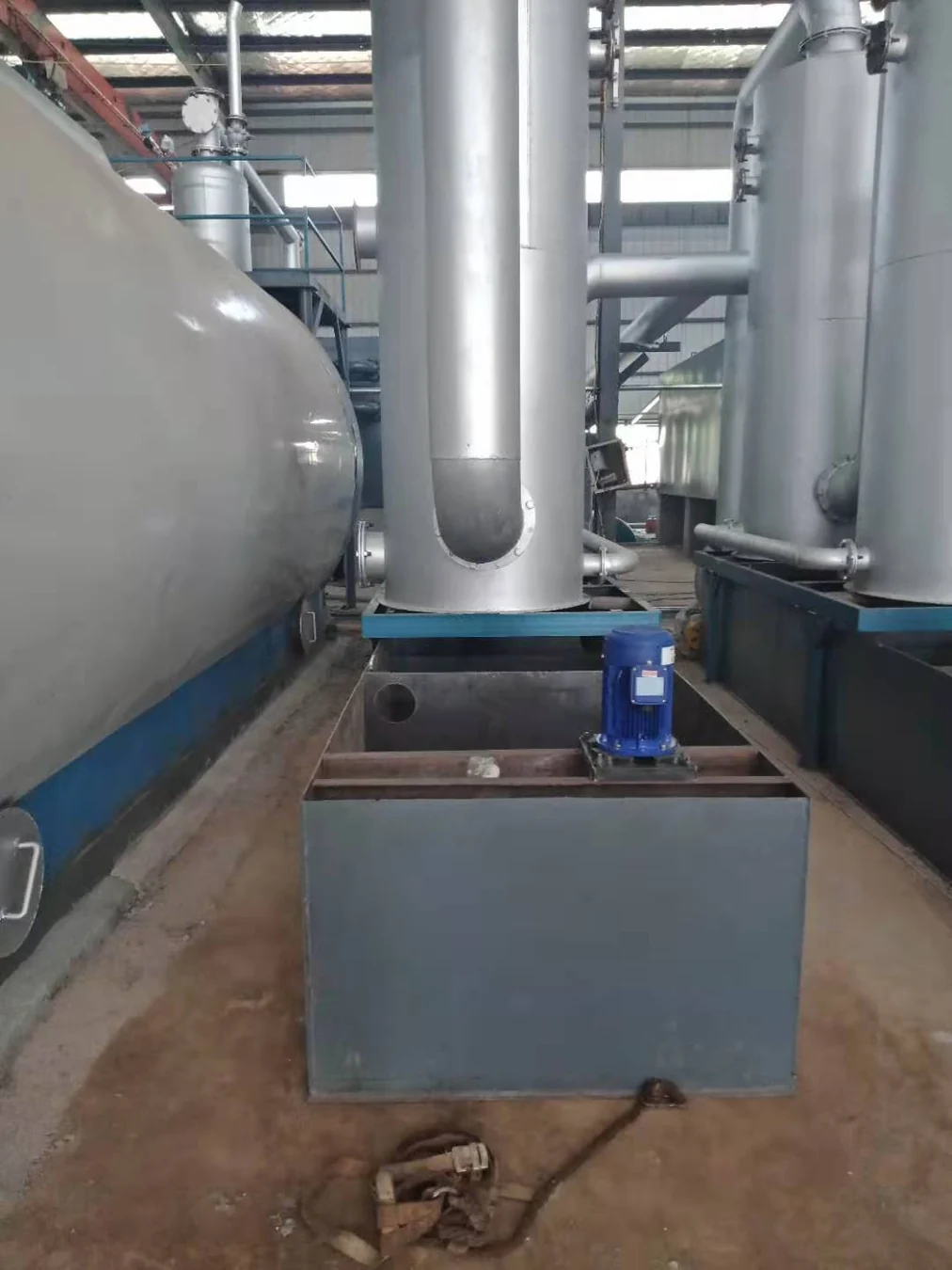
Photo 2

Process detail at the Chibi site showing the feedstock preparation and loading area of one reactor line. Photo taken during installation and commissioning in 2018.
Project Specifications
| Item | Project specification |
|---|---|
| Location | Chibi, Hubei, China |
| Project year | 2018 |
| Status | Historical archive project - delivered and commissioned in 2018 |
| Feedstock | Waste tires (whole or cut) |
| System | Batch pyrolysis (XY-8-P/PB class) |
| Number of units | 4 |
| Capacity per unit | 12 TPD (design) |
| Combined design capacity | 48 TPD |
| Production model | Staggered batch cycles across four lines |
| Main recovered streams | Pyrolysis oil (fuel oil), recovered carbonaceous material, steel wire; non-condensable gas may be returned to heating where the installed design and operating conditions permit |
| Supplier | Shangqiu Jinpeng Industrial Co., Ltd. |
What the Project Demonstrates
This project demonstrates what a four-line batch site at county scale is really about: a working schedule rather than a reactor count. Four units of the same class, staggered on roughly 24-hour cycles, give a modest crew a manageable daily rhythm of loading, monitoring, and discharge, and give the site tolerance for irregular feedstock supply. For a similar client evaluating a mid-scale tire pyrolysis plant, the points to examine are intake planning and storage for a bounded catchment, the loading and discharge windows and how they are staffed, and how many lines can be run economically at the expected intake level. The value of this archive entry is as a reference for that sizing and scheduling logic.
About Jinpeng
Shangqiu Jinpeng Industrial Co., Ltd. designs and manufactures batch, semi-continuous, and continuous pyrolysis plants, oil distillation systems, and supporting equipment for waste tires, waste plastics, oil sludge, rubber-derived materials, and other suitable carbon-rich feedstocks. Project configuration is developed around material characteristics, production objectives, site conditions, and applicable local requirements. For project discussions, visit www.pyrolysis-machine.com.
Disclaimer
All capacities in this article are design values; actual throughput depends on feedstock type and condition, operating practices, and site conditions. Product yields and properties vary with feedstock and process conditions and should be confirmed by testing of the actual feed processed. Energy and emissions performance depends on the auxiliary systems installed and on actual operation, and the final design must comply with applicable local regulations.
Archive Note: This retrospective is based on Jinpeng's project records and photographs from the original delivery and commissioning period. It describes the documented project configuration and does not constitute verification of the plant's current operating status.