Subtitle: A three-unit, 36 TPD design-capacity batch pyrolysis plant sited inside Shandong's tire and rubber manufacturing cluster, where feedstock proximity shifts the design effort from long-haul intake to cadence planning and short-radius output handling.
Project Details
- Project Location
- Weifang, Shandong Province, China
- Configuration
- Three XY-8-P/PB batch-type horizontal rotary pyrolysis units
- Combined Design Capacity
- 36 TPD (3 × 12 TPD per-unit design capacity)
- Feedstock
- Waste tires
- Project Year
- 2018
- Original Project Status
- Delivered and commissioned in 2018
- Current Operating Status
- Not independently verified
- Supplier
- Shangqiu Jinpeng Industrial Co., Ltd. (PYROJIN)
Opening
For most pyrolysis projects the decisive planning question is distance: how far scrap tires must travel to reach the reactor. The three-unit batch project in Weifang, Shandong, starts from the opposite premise. Shandong is one of China's largest tire-manufacturing provinces, and Weifang sits inside that tire and rubber cluster, among tire plants, rubber-product factories, and dense trucking corridors. When feedstock is close, the interesting problems change: intake planning becomes a matter of cadence and competition rather than haul radius, output handling becomes a matter of matching batch-sized lots to nearby offtakers, and three units become a deliberate mid-scale balance between regional supply and flexible batch operation. This archive project, delivered and commissioned in 2018, shows how that balance was configured.
Project Background & Configuration Logic
Weifang's position inside Shandong's tire and rubber cluster shapes the project in two directions. On the intake side, a concentrated manufacturing region generates scrap from several sources at once - factory offcuts and rejected casings from tire and rubber-product lines, plus end-of-life tires from the dense road-freight and private-vehicle fleets the province's manufacturing economy supports. The collection radius a site must cover is correspondingly short, and supply arrives in regular, predictable volumes. The corollary is competition: the same concentrated supply attracts retreaders, other recyclers, and co-processing industries, so intake planning must assume a shared, not exclusive, feedstock pool.
The configuration was designed around that condition. Three XY-8-P/PB batch units, each with a 12 TPD design capacity, give a combined 36 TPD of design throughput - enough to absorb the steady supply a cluster region can offer, yet modular enough to adapt when competition or market conditions change. In batch pyrolysis, scale is built from independent reactors rather than one large train; three units sit between a single-line entry plant and a large multi-line site - enough lines to justify shared utilities and labor, few enough to keep intake, storage, and scheduling manageable. Proximity removes the transport constraint, so the real work is organizing material flow around three reactors running on a roughly 24-hour batch cycle.
Core Technology & Production Analysis
Intake and feedstock preparation in a supply-dense region
When feedstock is close, the intake problem stops being "how far" and becomes "how steadily." A 36 TPD combined design capacity must be fed at roughly one batch of tires per unit per day, so intake works to a daily cadence of predictable deliveries, screened and sorted before storage, with buffer stock to keep the next loading on time. Cluster-derived streams are heterogeneous - passenger-car, truck and bus, and occasional off-the-road tires differ in size, steel content, and rubber composition - so consistent batches matter more here than at a remote site with one dominant tire type. The XY-8-P/PB system accepts whole or cut tires loaded in batches, and the horizontal rotary reactor turns the charge for even heat distribution under low-pressure, inert-atmosphere, micro-negative-pressure conditions designed to keep the pyrolysis zone anaerobic and contained; intake screening and batch segregation, not reactor design alone, determine how predictably each cycle runs.
Three units as a mid-scale balance
The three-unit arrangement is a capacity decision with operational consequences. Each reactor is an independent batch machine, so the site is never a single point of failure: one unit can be cooled and opened for maintenance while the other two continue their cycles, and the compact three-line footprint keeps labor modest at one to two operators with shared oversight. The balance is deliberately mid-scale - larger than an entry-level two-unit site, smaller than the six- and ten-line installations in Jinpeng's archive of the same period - sized to a catchment that is dense but not unlimited.
Batch cycling and staggered scheduling
Each unit runs a typical batch cycle of roughly 22 to 24 hours, covering loading, preheating, the pyrolysis phase, cooling, and discharge. With three reactors, the practical work is staggering those cycles so loading, discharge, and product collection do not collide: offsetting the lines spreads demand for shared resources - loading equipment, cooling water, operators - across the day and yields a steadier flow of output lots. Staggering also lets the operator run different tire classes in different reactors - a batch of heavily steel-reinforced truck tires on its own schedule rather than in a general feed.
Output handling close to offtake
A batch plant produces outputs in discrete lots, and a site inside a manufacturing cluster has short outbound distances to potential users of all three recovered streams. The pyrolysis oil is a fuel oil whose properties depend on the feed and operating conditions; upgrading it to engine-grade fuel would require further distillation and testing, so it is handled as fuel oil with storage planned around the batch cadence of production. The solid residue is recovered carbonaceous material - not commercial-grade carbon black unless deep-processed and tested for the application - stored under cover and dispatched in lots; the steel wire recovered at discharge is a clean, easily baled stream with an established recycling market. Proximity shortens the haul for each stream; the planning task is matching lot sizes and storage capacity to the offtake rhythm.
Gas handling and environmental design
The heating system and gas handling are designed around two principles: energy recovery and controlled discharge. Non-condensable gas may be returned to the heating system where the installed design and operating conditions permit, cutting external fuel demand; flue gas from heating passes through a spray tower with alkaline solution and an adsorption tower for desulfurization and dedusting, designed to meet applicable local emission requirements under proper operating conditions. None of this is a claim of emission-controlleds - the environmental design is a matter of installed equipment, operating discipline, and compliance with the requirements that apply at the site.
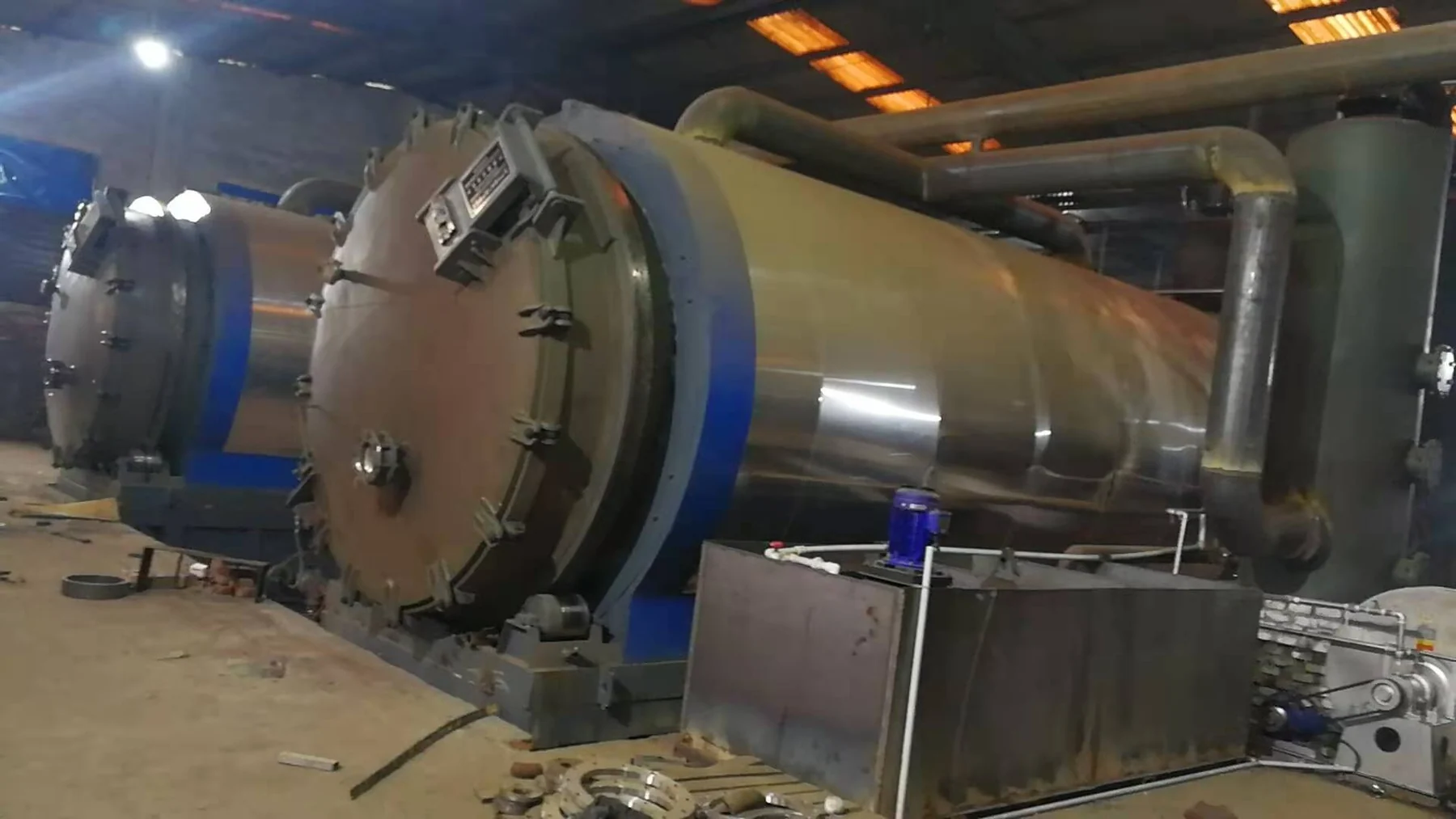
Photo 1

Overall view of the three-unit batch pyrolysis site in Weifang, Shandong, showing the three reactor lines and the shared processing area at mid-scale. Photo taken during installation and commissioning in 2018.
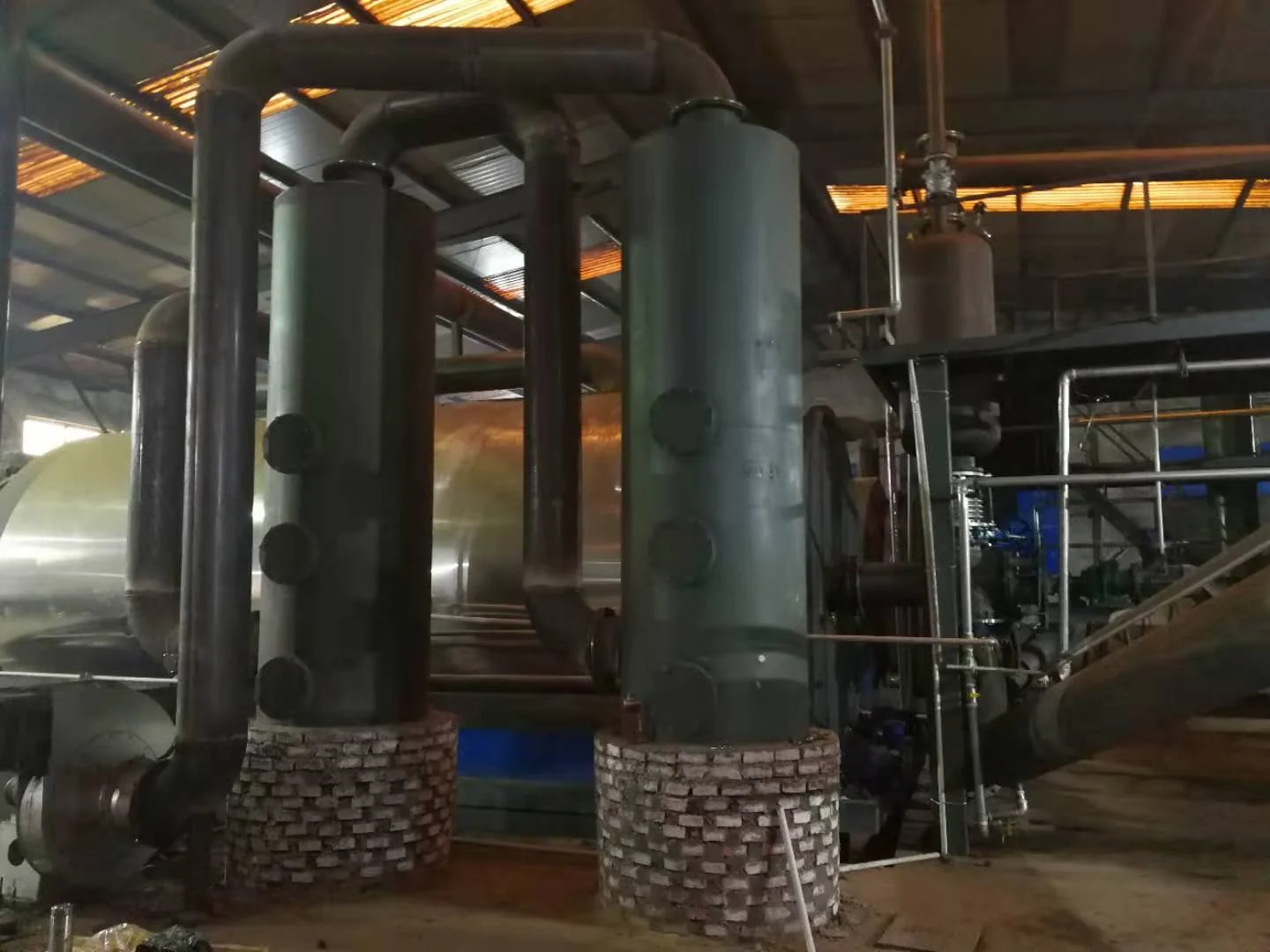
Photo 2

Close view of a reactor and its loading arrangement at the Weifang site, showing batch charging and the drive, heating, and connection points shared across the three lines. Photo taken during installation and commissioning in 2018.
Project Specifications
| Item | Project specification |
|---|---|
| Location | Weifang, Shandong Province, China |
| Project year | 2018 |
| Status | Historical archive project; delivered and commissioned in 2018; current operating status not independently verified |
| Feedstock | Waste tires |
| System | XY-8-P/PB batch-type horizontal rotary pyrolysis |
| Number of units | 3 |
| Capacity per unit | 12 TPD (design capacity) |
| Combined design capacity | 36 TPD (3 × 12 TPD) |
| Production model | Batch cycling with staggered scheduling across three reactors |
| Main recovered streams | Pyrolysis oil (fuel oil), recovered carbonaceous material, steel wire, non-condensable gas |
| Supplier | Shangqiu Jinpeng Industrial Co., Ltd. (PYROJIN) |
What the Project Demonstrates
This archive project demonstrates how a mid-scale batch plant is configured when feedstock proximity - not feedstock scarcity - is the governing condition. For prospective operators inside a manufacturing cluster, the reference value is the balance it strikes: three units large enough to matter to a dense supply region, small enough to keep intake, storage, and scheduling under control, and staggered so that shared utilities and a modest labor team carry the throughput. Evaluators should watch the material-flow logic more than the reactor count: how intake is screened and batched, how the three cycles are offset, how lot-sized outputs match the offtake rhythm, and how gas and flue-gas treatment integrate with the heating system. These elements determine whether proximity becomes steady production or a congested yard.
About Jinpeng
Shangqiu Jinpeng Industrial Co., Ltd. designs and manufactures batch, semi-continuous, and continuous pyrolysis plants, oil distillation systems, and supporting equipment for waste tires, waste plastics, oil sludge, rubber-derived materials, and other suitable carbon-rich feedstocks. Project configuration is developed around material characteristics, production objectives, site conditions, and applicable local requirements. For project discussions, visit www.pyrolysis-machine.com.
Disclaimer
Capacities in this article are design capacities; actual throughput depends on feedstock properties and operating conditions. Yields and product properties are feedstock- and operation-dependent and must be established by testing on the actual material. Energy recovery and emissions performance depend on the auxiliary systems installed and on how the plant is operated, and the final design must comply with the regulations applicable at the site.
Archive Note: This retrospective is based on Jinpeng's project records and photographs from the original delivery and commissioning period. It describes the documented project configuration and does not constitute verification of the plant's current operating status.